
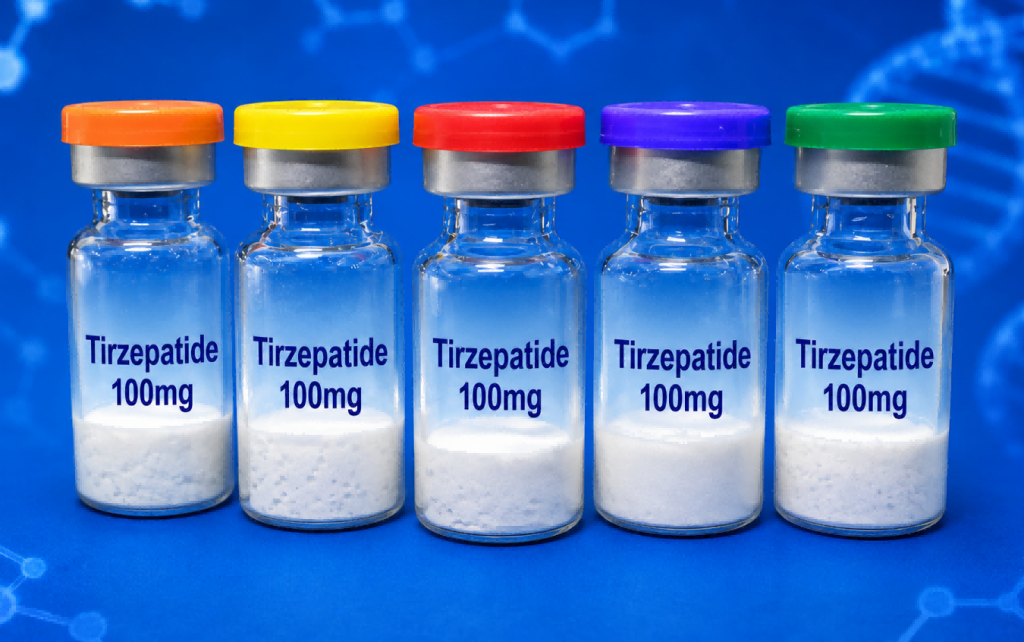
What Is Tirzepatide?
Tirzepatide is a synthetic peptide designed to activate both the GIP receptor and GLP-1 receptor.
Its molecular architecture is substantially more complex than that of a short research peptide. Tirzepatide contains 39 amino-acid residues, modified amino acids and a lipid-containing side chain.
SUNONE supplies research-grade Tirzepatide, CAS 2023788-19-2, for qualified laboratory, analytical and manufacturing research.
SUNONE Tirzepatide Product Page:
Why Tirzepatide Purity Is Only One Quality Parameter
A common purchasing question is:
“Is the Tirzepatide 99% pure?”
That is important—but incomplete.
HPLC purity generally describes the proportion of chromatographic material associated with the main peak under a defined analytical method.
It does not, by itself, answer every identity and quality question.
For a structurally complex peptide such as Tirzepatide, researchers may also need to consider:
- peptide sequence identity;
- molecular mass;
- related peptide impurities;
- truncated sequences;
- degradation products;
- modified side-chain integrity;
- counterion or chemical form;
- batch-to-batch consistency.
Therefore:
high HPLC purity ≠ complete peptide characterization.
Why Is Tirzepatide More Complex Than a Simple Peptide?
Tirzepatide is based on a GIP-related peptide sequence but includes several deliberate structural modifications.
Regulated pharmaceutical documentation describes features including:
- aminoisobutyric acid residues;
- a C-terminal amide;
- a modified lysine residue;
- a long-chain fatty diacid attached through a linker.
These structural elements help explain why Tirzepatide cannot be fully characterized simply by checking whether “a peptide peak” appears in HPLC.
The intended molecular entity itself must be confirmed.
What Does LC-MS Add to Tirzepatide Analysis?
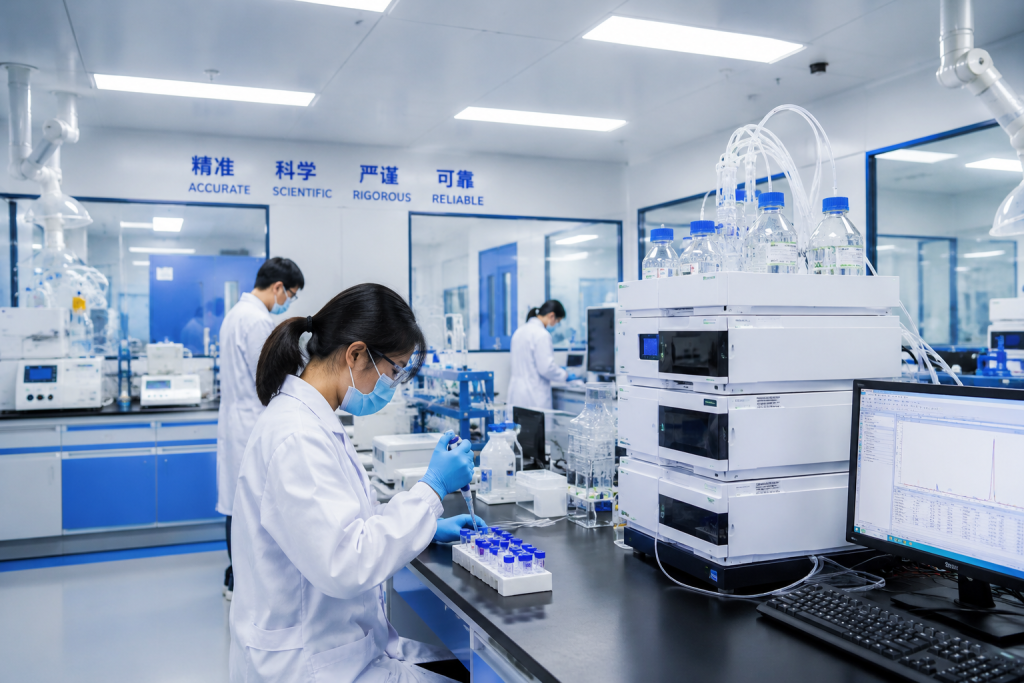
Liquid chromatography–mass spectrometry (LC-MS) can provide information that complements HPLC purity testing.
Depending on the analytical method, LC-MS may help researchers examine:
- expected molecular mass;
- peptide-related impurities;
- oxidation or degradation products;
- sequence-related variants;
- unexpected reaction products.
For synthetic peptide research, chromatographic purity and mass-based identity are therefore complementary rather than interchangeable.
A useful framework is:
HPLC → purity profile
MS / LC-MS → molecular identity and impurity characterization
Why Tirzepatide Impurities Matter
Peptide-related impurities are not always obvious from a single headline purity percentage.
Recent research involving compounded Tirzepatide-containing products identified an unexpected impurity produced through a chemical interaction in certain Tirzepatide/B12 combinations.
That finding does not mean all Tirzepatide materials contain the same impurity.
Instead, it demonstrates a broader analytical principle:
formulation environment and chemical interactions can create new peptide-related species.
For research procurement, this reinforces the value of batch-specific analytical documentation.
What Do Tirzepatide Reviews Say?
Current online Tirzepatide reviews are generally positive.
Users of regulated Tirzepatide medicines frequently report:
- reduced appetite;
- improved satiety;
- reduced food-related preoccupation;
- meaningful weight-related changes;
- improved glucose-related outcomes.
Negative or neutral reviews commonly mention:
- nausea;
- constipation;
- diarrhea;
- vomiting;
- fatigue;
- abdominal discomfort;
- limited perceived effect.
However, these reviews largely concern prescription products such as Mounjaro or Zepbound.
They should not be interpreted as evidence for a research-grade Tirzepatide raw material.
Prescription-drug reviews ≠ evidence of SUNONE Research Grade Tirzepatide performance.
Tirzepatide Research Grade vs Approved Pharmaceutical Tirzepatide
FDA-regulated Tirzepatide products are finished pharmaceutical medicines manufactured under defined drug-product specifications.
SUNONE Tirzepatide is supplied as Research Grade material.
These are different product categories.
Approved pharmaceutical evidence does not automatically demonstrate:
- formulation equivalence;
- clinical safety;
- clinical efficacy;
- sterility;
- bioavailability;
- pharmaceutical interchangeability
of a research-grade material.
This distinction should remain clear in scientific and procurement discussions.

What Should Researchers Check When Choosing a Tirzepatide Supplier?
For laboratories evaluating a Tirzepatide supplier, a useful quality review can include:
1. Batch-Specific HPLC
The applicable chromatogram should support the stated purity of that specific lot.
2. Molecular-Mass Confirmation
Mass-related analytical data should be consistent with the intended Tirzepatide molecule.
3. COA Traceability
A Tirzepatide COA should correspond to the actual batch supplied.
4. Impurity Information
Researchers should consider whether relevant peptide-related impurities or degradation products are addressed by the analytical package.
5. Chemical Form
Exact chemical form and applicable analytical specifications should be verified against batch documentation.
SUNONE currently lists Tirzepatide as:
Product: Tirzepatide
Synonym: LY3298176
CAS: 2023788-19-2
Formula: C225H348N48O68
Molecular Weight: approximately 4813 g/mol
Form: Lyophilized Powder
Grade: Research Grade
Exact purity and analytical specifications should be confirmed from the applicable batch-specific COA.
Final Thoughts
For Tirzepatide research, a high purity number is useful—but it should not become the entire quality discussion.
A stronger analytical framework is:
Tirzepatide identity → HPLC purity → molecular-mass confirmation → impurity profile → batch-specific COA → research reproducibility.
For laboratories comparing research-grade Tirzepatide suppliers, the most useful question may therefore be not simply:
“What is the purity?”
but:
“What analytical evidence supports the identity and quality of this specific Tirzepatide batch?”
SUNONE research peptide is for qualified labrtorynt, diagnois, druc tor mmatct or veteimant, use.research only, Not for human consumption, clinical treame.
Leave a Reply