
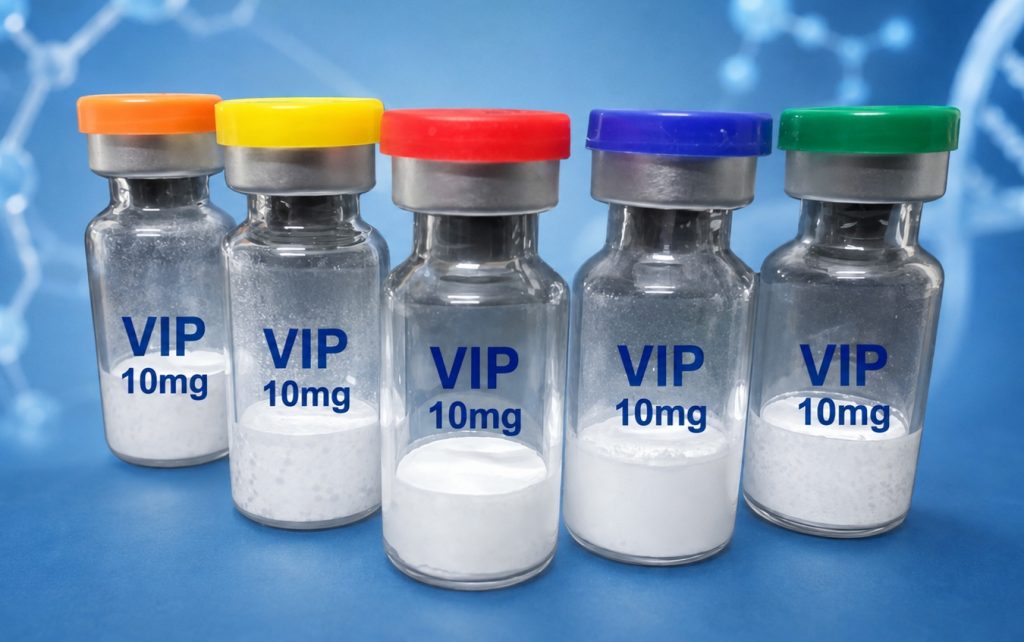
What Is Vasoactive Intestinal Peptide?
Vasoactive Intestinal Peptide (VIP) is a naturally occurring 28-amino-acid neuropeptide involved in a broad range of cellular and receptor-signaling pathways.
Despite its name, VIP research is not limited to the intestine.
VIP signaling has been investigated in:
- nervous-system biology;
- gastrointestinal signaling;
- vascular biology;
- immune pathways;
- pulmonary research;
- endocrine signaling.
SUNONE supplies research-grade Vasoactive Intestinal Peptide, CAS 37221-79-7, for qualified laboratory, analytical and manufacturing applications.
SUNONE VIP Product Page:
VIP Research Is Not Only About VPAC1 and VPAC2
VIP primarily interacts with two class B G-protein-coupled receptors:
VPAC1 and VPAC2.
Both receptors can activate intracellular signaling pathways involving adenylate cyclase and cyclic AMP.
That receptor biology is important, but it is only one part of VIP research.
For laboratories, another major issue is:
How much intact VIP peptide is actually present during an experiment?
That question matters because VIP is highly sensitive to proteolytic degradation.
Why Is VIP Peptide Stability Important?
Native VIP has a relatively short biological lifetime.
Published research describes rapid enzymatic degradation, with circulating VIP showing a very short in-vivo half-life.
The N-terminal region is particularly important.
Removal of the first residues by peptidases such as DPP-IV can sharply reduce receptor affinity.
This creates a useful research framework:
VIP sequence → peptide integrity → VPAC receptor binding → cellular signaling.
If peptide integrity changes, experimental receptor activity may also change.
For this reason, VIP purity alone does not tell the complete analytical story.
VIP Purity vs VIP Identity
A laboratory may see a specification such as:
“VIP ≥99% HPLC.”
That is useful, but researchers should also ask:
- Is the main peak the intended 28-aa VIP molecule?
- Is the molecular mass consistent with the target peptide?
- Are truncated or degraded peptide species characterized?
- What chemical form is supplied?
- Does the batch-specific COA match the material being tested?
For lab research, high purity and correct molecular identity are related but not identical concepts.
This distinction is especially important for a degradation-sensitive peptide such as VIP.

VIP and Aviptadil: Closely Related Names, Different Product Contexts
The term Aviptadil is commonly used for synthetic human VIP in pharmaceutical research.
That creates another potential search misunderstanding.
Scientific literature involving an Aviptadil pharmaceutical formulation does not automatically establish the:
- stability;
- formulation characteristics;
- clinical safety;
- clinical efficacy;
- pharmaceutical equivalence
of a research-grade VIP raw material.
SUNONE VIP is supplied as Research Grade peptide material, not as an approved finished pharmaceutical product.
Researchers should therefore separate:
VIP molecular identity
from
Aviptadil pharmaceutical formulation and clinical evidence.
What Does Clinical Aviptadil Research Show?
Aviptadil has been studied in several respiratory-disease clinical programs.
Some early research reported potentially favorable biological or survival-related signals.
However, larger randomized evidence has been mixed.
Trials in severe COVID-19 respiratory failure did not consistently demonstrate a statistically significant improvement in their primary clinical outcomes compared with placebo.
More recent evidence reviews have therefore emphasized that promising mechanistic findings should not be confused with established clinical efficacy.
For VIP research, this is an important reminder:
biological activity ≠ proven therapeutic outcome.
What Do VIP Peptide Reviews Say?
Current online VIP peptide reviews are highly variable.
Positive anecdotal experiences sometimes mention:
- improved perceived energy;
- clearer thinking;
- improved subjective well-being;
- changes in fatigue;
- improved perceived recovery.
Negative or neutral reports include:
- fatigue;
- flu-like feelings;
- flushing;
- headache;
- anxiety;
- bloating;
- feeling generally unwell;
- no meaningful improvement.
These reports are difficult to interpret.
Online discussions may involve nasal products, compounded formulations, research peptides, prescription medications and multiple underlying conditions.
Therefore:
VIP reviews should be treated as anecdotal search sentiment, not controlled scientific evidence.

Why VIP Should Not Be Treated as a “Single-Purpose Peptide”
VIP is sometimes marketed online using narrow labels such as:
“immune peptide,”
“gut peptide,” or
“recovery peptide.”
These descriptions oversimplify the molecule.
VIP is a pleiotropic neuropeptide acting through receptors distributed across multiple tissues.
A more scientifically useful model is:
28-aa VIP → VPAC1 / VPAC2 → cAMP signaling → tissue-specific response.
The resulting biology depends heavily on:
- receptor distribution;
- cell type;
- peptide concentration;
- peptide integrity;
- experimental model.
This makes experimental context particularly important.
What Should Researchers Check When Choosing a VIP Peptide Supplier?
For professional Vasoactive Intestinal Peptide research, supplier evaluation should include more than a product name.
Sequence Identity
The material should correspond to the intended 28-amino-acid human VIP sequence.
HPLC Purity
Batch-specific chromatography should support the reported purity.
Molecular-Mass Verification
Mass-related analytical documentation can help confirm the intended peptide.
Peptide Integrity
Because VIP is sensitive to degradation, laboratories should consider whether analytical documentation supports intact peptide identity.
Batch-Specific COA
A current VIP COA improves lot-level traceability and experimental reproducibility.
SUNONE currently lists:
Product: Vasoactive Intestinal Peptide (VIP)
Synonyms: VIP, Vasoactive Intestinal Polypeptide, Aviptadil
CAS: 37221-79-7
Formula: C147H237N43O43S
Molecular Weight: 3326.8 g/mol
Sequence Length: 28 amino acids
Purity: ≥99% HPLC
Form: Lyophilized
Grade: Research Grade
VIP Research: Follow the Intact Peptide
A common search question is:
“What does VIP peptide do?”
For laboratory research, a better question is:
“Is the intact 28-amino-acid VIP molecule reaching the intended receptor system in the experimental model?”
That creates a stronger scientific framework:
VIP molecular identity → peptide stability → VPAC1 / VPAC2 binding → cAMP signaling → experimental response.
For laboratories evaluating a research-grade VIP peptide supplier, sequence identity, molecular integrity, HPLC purity and batch-specific analytical documentation are more meaningful than generalized therapeutic claims.
SUNONE research peptide is for qualified labrtorynt, diagnois, druc tor mmatct or veteimant, use.research only, Not for human consumption, clinical treame.
Leave a Reply