
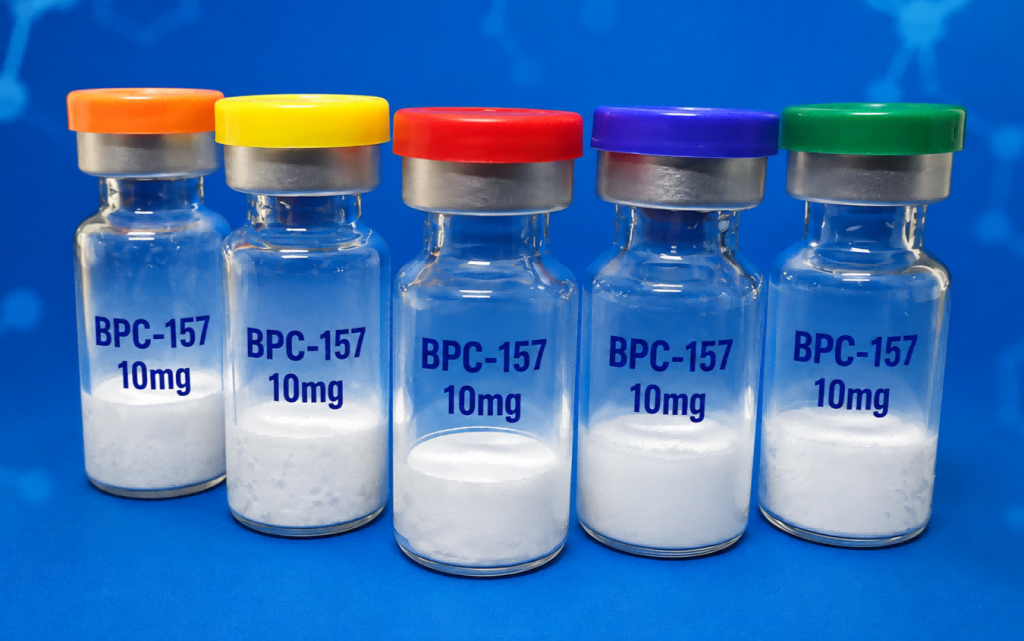
What Is BPC-157?
BPC-157 is a synthetic 15-amino-acid peptide widely investigated in laboratory models involving tissue remodeling, angiogenesis, inflammatory signaling and regenerative biology.
SUNONE supplies research-grade BPC-157, CAS 137525-51-0, for qualified laboratory, analytical and manufacturing research.
SUNONE BPC-157 Product Page:
Why BPC-157 Research Attracts Attention
BPC-157 has produced a broad range of findings in preclinical research.
Animal and cellular studies have investigated pathways involving:
- angiogenesis;
- fibroblast activity;
- nitric oxide signaling;
- tissue remodeling;
- tendon and muscle repair;
- inflammatory cytokines.
This has generated substantial interest in BPC-157.
However, the evidence hierarchy matters.
A 2025 systematic review identified 36 relevant studies, of which 35 were preclinical and only one was clinical.
That means the volume of laboratory evidence is much greater than the amount of validated human evidence.
Why Human Evidence Is Still a Major Limitation
Recent reviews continue to describe BPC-157 as investigational.
Although several small human pilot reports exist, there are still no large, rigorous clinical programs establishing broad safety and efficacy.
Therefore:
strong preclinical evidence ≠ established human therapeutic evidence.
For research suppliers and laboratories, this evidence gap makes material quality even more important.
If biological conclusions are being drawn from experimental work, researchers need confidence that the tested peptide is actually the intended molecular material.
Why HPLC Purity Is Not the Whole Story
A specification such as:
BPC-157 ≥99% HPLC
is valuable, but it does not answer every analytical question.
Peptide materials may also require consideration of:
- deletion sequences;
- truncated peptides;
- oxidation products;
- epimerization;
- aggregation;
- synthesis-related impurities;
- residual processing materials;
- molecular identity.
Two samples can both report high HPLC purity while still differing in their impurity profiles.
This is particularly important when human safety data are limited.

FDA Has Highlighted Peptide-Related Impurity Risks
FDA has specifically discussed BPC-157 in the context of compounded peptide substances.
Its current safety assessment has highlighted potential concerns involving:
peptide-related impurities
aggregation
and
immunogenicity.
FDA has also stated that there is insufficient clinical safety information to fully characterize BPC-157.
This creates an important research-quality principle:
the less mature the clinical evidence, the more important precise material characterization becomes.
What Does Current BPC-157 Research Show?
Recent systematic and narrative reviews continue to find potentially interesting preclinical signals in areas such as:
- tendon repair;
- muscle injury;
- ligament models;
- bone healing;
- gastrointestinal biology;
- vascular and inflammatory signaling.
However, these findings are dominated by animal and laboratory studies.
A 2025 orthopedic systematic review concluded that BPC-157 showed promising preclinical effects but found essentially no robust clinical safety evidence.
A 2026 biopharmaceutical review similarly emphasized the lack of validated formulations, standardized pharmacokinetics and advanced clinical development.
What Do Current BPC-157 Reviews Say?
Current online BPC-157 reviews are highly mixed.
Positive anecdotal reports sometimes mention:
- improved perceived recovery;
- improved digestion;
- reduced perceived inflammation;
- improved joint or soft-tissue comfort;
- improved sleep.
Negative reports include:
- fatigue;
- anxiety;
- brain fog;
- unusual mood changes;
- flu-like sensations;
- no noticeable effect;
- concern about product quality.
These experiences cannot determine whether an effect came from BPC-157 itself, impurities, another ingredient, product quality or unrelated factors.
Therefore:
BPC-157 reviews are anecdotal search sentiment—not controlled clinical evidence.
They also should not be interpreted as reviews of SUNONE Research Grade BPC-157.

Why Supplier Quality Matters More When Evidence Is Sparse
When a peptide lacks an established pharmaceutical standard, supplier documentation becomes particularly important for reproducible laboratory work.
Researchers should consider:
Identity
Does the material match the intended BPC-157 molecule?
Purity
What does HPLC show for the main peptide peak?
Impurity Profile
Are peptide-related impurities appropriately characterized?
Molecular Mass
Does MS support the expected molecular identity?
Batch Consistency
Are specifications consistent across research lots?
Documentation
Are batch-specific COA, SDS and analytical data available?
What Should Researchers Check When Choosing a BPC-157 Supplier?
SUNONE currently lists:
Product: BPC-157
Synonyms: BPC 157, Bepecin, BPC 15
CAS: 137525-51-0
Formula: C62H98N16O22
Molecular Weight: 1419.5 g/mol
Grade: Research Grade
Form: Lyophilized Powder
Storage: 2–8°C according to applicable COA/SDS
Pack Sizes: 5 mg × 10 vials and 10 mg × 10 vials
Because published website specifications may be updated, the final purity, identity, storage requirements and analytical specifications should always be verified against the batch-specific Certificate of Analysis (COA).
Final Thoughts
A common Google search asks:
“Does BPC-157 work?”
For laboratory researchers, a more important question is:
“How well characterized is the BPC-157 material used in the experiment?”
A stronger scientific framework is:
molecular identity → HPLC purity → impurity profile → aggregation risk → experimental reproducibility → biological interpretation.
For laboratories comparing a BPC-157 supplier, analytical transparency and batch-specific documentation should take priority over consumer testimonials or broad healing claims.
SUNONE research peptide is for qualified labrtorynt, diagnois, druc tor mmatct or veteimant, use.research only, Not for human consumption, clinical treame.
Leave a Reply