
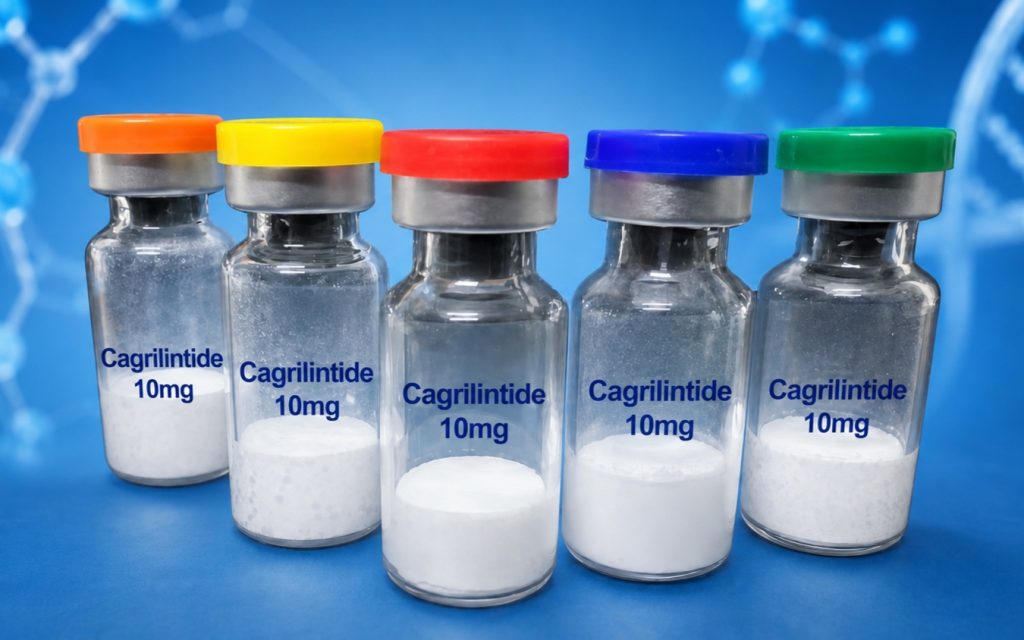
What Is Cagrilintide?
Cagrilintide is an investigational long-acting amylin analogue being studied in metabolic and appetite-regulation research.
It is often described online as an “appetite-suppression peptide,” but that description does not capture its full pharmacology.
Cagrilintide interacts with a family of amylin and calcitonin receptors, making receptor biology an important part of understanding current Cagrilintide research.
SUNONE supplies Research Grade Cagrilintide for qualified laboratory, analytical and biopharmaceutical research.
SUNONE Cagrilintide Product Page:
What Is an Amylin Receptor?
Amylin receptor biology is more complex than one peptide binding to one receptor.
Functional amylin receptors are formed when a calcitonin receptor (CTR) associates with receptor activity-modifying proteins known as RAMPs.
Different RAMP combinations produce different receptor subtypes, including:
- AMY1R;
- AMY2R;
- AMY3R.
These receptors can differ in ligand recognition, signaling behavior and tissue distribution.
This is why researchers should not treat “amylin receptor activation” as a single uniform mechanism.
How Does Cagrilintide Interact With These Receptors?
Structural research published in 2025 examined Cagrilintide bound to:
AMY1R, AMY2R, AMY3R and CTR.
The study demonstrated that Cagrilintide can activate multiple receptors within the amylin/calcitonin receptor family.
This gives researchers a more useful framework than simply calling Cagrilintide a satiety peptide:
Cagrilintide → CTR/RAMP complexes → multiple amylin receptor subtypes → downstream signaling.
Why AMY1R and AMY3R Matter
Another 2025 study investigated Cagrilintide pharmacology in experimental models lacking specific RAMP proteins.
The findings supported important roles for AMY1R and AMY3R in the body-weight-related effects observed in the model.
This does not mean that one receptor subtype alone explains all Cagrilintide biology.
Instead, it illustrates why receptor subtype pharmacology matters when interpreting peptide research.

What Does Current Human Cagrilintide Research Show?
Cagrilintide has also progressed into late-stage clinical development.
A Phase 3 REDEFINE 1 analysis of Cagrilintide monotherapy reported an average body-weight reduction of approximately 11.8% compared with 2.3% for placebo after 68 weeks in the trial-product estimand.
The most frequently reported adverse events were gastrointestinal, including nausea, vomiting, diarrhea and constipation, and were generally described as transient and mild to moderate.
However, Cagrilintide remains an investigational medicine.
Current Phase 3 RENEW studies are continuing to evaluate Cagrilintide as a monotherapy.
Therefore:
late-stage clinical evidence does not equal regulatory approval.
Cagrilintide Is Not the Same as CagriSema
Another common Google search problem is mixing Cagrilintide with CagriSema.
They are not the same research entity.
Cagrilintide is the long-acting amylin analogue.
CagriSema combines Cagrilintide with Semaglutide.
Clinical results from CagriSema therefore cannot automatically be assigned to Cagrilintide monotherapy.
For evidence review:
Cagrilintide evidence ≠ CagriSema evidence.
The exact experimental material should always be identified first.
What Do Current Cagrilintide Reviews Say?
Current online Cagrilintide reviews show both positive and negative sentiment.
Positive anecdotal comments sometimes describe:
- reduced hunger;
- stronger satiety;
- less “food noise”;
- perceived progress after a prior weight-loss plateau.
Negative or neutral discussions report:
- nausea;
- fatigue;
- lethargy;
- dizziness or lightheadedness;
- no noticeable response in some users.
Many community posts involve Cagrilintide together with Tirzepatide, Retatrutide, Semaglutide or other compounds.
That creates major confounding.
The identity and analytical quality of materials discussed online are also frequently unknown.
Therefore:
online Cagrilintide reviews are anecdotal sentiment—not controlled evidence and not reviews of SUNONE Cagrilintide.

Why Analytical Identity Still Matters
For receptor-pharmacology research, peptide identity matters as much as headline purity.
Researchers should consider:
- molecular identity;
- molecular mass;
- peptide sequence;
- chemical modifications;
- HPLC purity;
- MS confirmation where applicable;
- peptide-related impurities;
- batch consistency.
A material labelled “Cagrilintide” should be analytically characterized before receptor-specific research conclusions are drawn.
What Should Researchers Check When Choosing a Cagrilintide Supplier?
SUNONE currently lists:
Product: Cagrilintide
CAS: 1415456-99-3
Formula: C194H312N54O59S2
Molecular Weight: 4409 g/mol
Purity / Grade: ≥99.6%, Research Grade
Form: Lyophilized Powder
Storage: 2–8°C, protect from light
Documentation: SDS, Certificate of Analysis and Specification Sheet
Researchers should confirm final identity, purity and analytical specifications using the applicable batch-specific documentation.
Final Thoughts
A common Google question is:
“How does Cagrilintide suppress appetite?”
For researchers, a more informative question is:
“Which amylin receptor complexes does Cagrilintide activate, and how do CTR and RAMP proteins influence its pharmacology?”
That produces a stronger scientific framework:
Cagrilintide identity → CTR → RAMP proteins → AMY1R/AMY2R/AMY3R → receptor signaling → preclinical evidence → human trials → analytical verification.
For laboratories comparing a Cagrilintide supplier, molecular identity, HPLC purity and batch-specific documentation should take priority over broad metabolic marketing claims.
SUNONE research peptide is for qualified labrtorynt, diagnois, druc tor mmatct or veteimant, use.research only, Not for human consumption, clinical treame.
Leave a Reply