
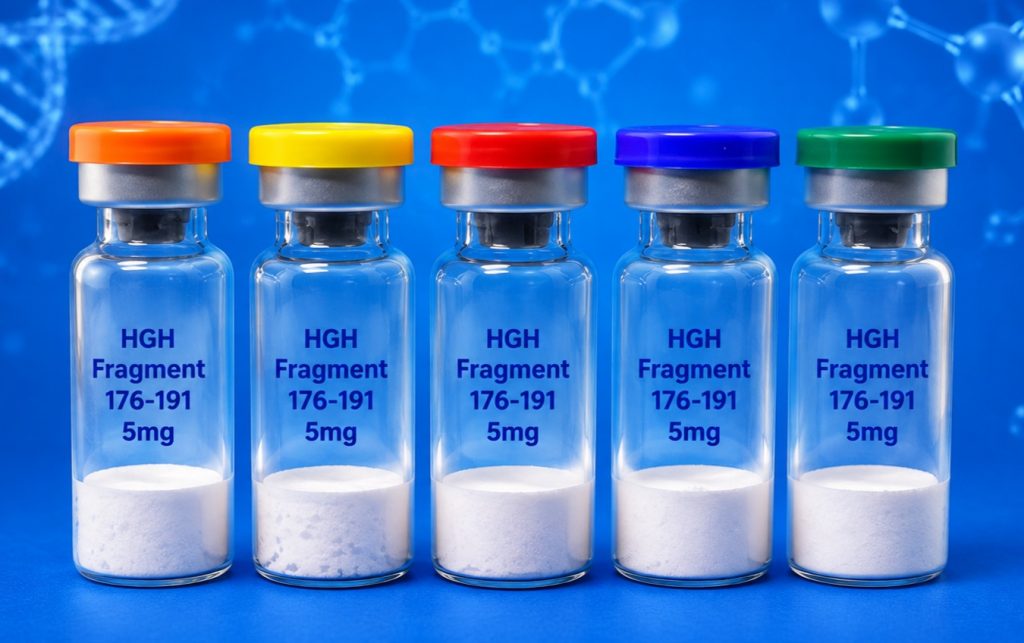
What Is HGH Fragment 176-191?
HGH Fragment 176-191 is a synthetic peptide corresponding to the C-terminal region of human growth hormone.
Full-length human growth hormone contains 191 amino acids, while HGH Fragment 176-191 represents only a small portion of the parent protein.
SUNONE supplies research-grade HGH Fragment 176-191 for qualified laboratory, analytical and peptide-related biochemical research.
SUNONE HGH Fragment 176-191 Product Page:
Why Does the Sequence Number Matter?
One of the biggest problems in online HGH Fragment research is terminology.
Search results frequently use:
- HGH Fragment 176-191;
- hGH 177-191;
- GH Fragment;
- AOD-9604
as though they refer to identical research materials.
They do not necessarily do so.
Historical research often investigated the 177-191 C-terminal sequence, while commercial HGH Fragment 176-191 materials are generally described as the 176-191 region.
AOD-9604 is another closely related but structurally modified peptide.
For researchers, this creates an important rule:
exact sequence identity should be checked before transferring published evidence to a research material.
What Did Early HGH Fragment Research Actually Find?
Early C-terminal growth-hormone research investigated whether metabolic activity could be separated from the growth-promoting functions of intact HGH.
A 1993 study evaluated synthetic hGH 177-191 in rat adipose-tissue experiments.
The fragment showed antilipogenic activity under the experimental conditions.
However, the same study reported no significant lipolytic effect when lipolysis was measured by glycerol release.
This is important because modern online descriptions often reduce the literature to:
“HGH Fragment directly burns fat.”
The original experimental record is more nuanced.

HGH Fragment 176-191 Is Not Full-Length HGH
Full-length HGH 191AA / somatropin is a complete 191-amino-acid protein.
HGH Fragment 176-191 contains only the C-terminal segment.
They therefore differ in:
- molecular size;
- sequence length;
- receptor interactions;
- biological functions;
- clinical evidence;
- analytical characterization.
Evidence from pharmaceutical somatropin should not automatically be assigned to a short HGH-derived fragment.
HGH Fragment 176-191 vs AOD-9604
These two research peptides are also frequently confused.
Both originate from the C-terminal region of human growth hormone, but AOD-9604 is an engineered related molecule with a different sequence specification.
More importantly, AOD-9604 progressed substantially further into human clinical development.
HGH Fragment 176-191 itself does not have a comparable modern human clinical evidence base.
Therefore:
AOD-9604 evidence ≠ HGH Fragment 176-191 evidence.
Researchers should identify which exact peptide was used before citing a clinical or mechanistic result.
What Do Current HGH Fragment 176-191 Reviews Say?
Current online HGH Fragment 176-191 reviews are highly mixed.
Positive anecdotal comments sometimes mention:
- perceived body-composition changes;
- reduced stubborn-fat appearance;
- improved results when combined with other research compounds.
Negative or neutral comments include:
- no noticeable effect;
- very limited body-composition change;
- the peptide being described as “weak”;
- poor value compared with other metabolic research compounds.
A major limitation is that many reviews involve HGH Fragment combined with CJC-1295, Ipamorelin, MOTS-c or other compounds.
This makes it impossible to attribute an observed outcome specifically to HGH Fragment 176-191.
Online reviews also rarely confirm peptide identity, purity or analytical quality.
Therefore:
HGH Fragment reviews are anecdotal search sentiment—not controlled clinical evidence.
They should not be interpreted as reviews of SUNONE Research Grade HGH Fragment 176-191.

Why Molecular Identity Matters More Than the Product Name
For short sequence-derived peptides, small structural differences can change which literature is relevant.
Researchers should verify:
- exact amino-acid sequence;
- residue numbering;
- termini;
- disulfide status where applicable;
- molecular mass;
- HPLC purity;
- MS identity;
- peptide-related impurities;
- batch consistency.
A label saying “HGH Fragment” alone is not enough for rigorous literature attribution.
What Should Researchers Check When Choosing an HGH Fragment 176-191 Supplier?
SUNONE currently lists:
Product: HGH Fragment 176-191
Synonyms: Somatotropin (176-191), HGH (176-191), Human Growth Hormone Fragment 176-191, GH Fragment 176-191
CAS: 66004-57-7
Formula: C78H123N23O22S2
Molecular Weight: 1799.1 g/mol
Purity: ≥98% HPLC
Form: Lyophilized Solid
Grade: Research / HPLC
Storage: 2–8°C, cold-chain
Documentation: Batch-specific COA, HPLC/MS data, SDS and specification information according to ordered specification
Final sequence, purity, chemical form and analytical results should be verified using the applicable batch-specific COA and supporting analytical documentation.
Final Thoughts
A common Google search asks:
“Does HGH Fragment 176-191 work like HGH?”
For researchers, the better question is:
“Which exact growth-hormone-derived sequence was studied in the paper I am reading?”
That produces a stronger scientific framework:
parent HGH sequence → fragment numbering → molecular identity → preclinical evidence → AOD-9604 distinction → human evidence gap → analytical verification.
For laboratories comparing an HGH Fragment 176-191 supplier, exact sequence identity, HPLC purity and batch-specific analytical documentation should take priority over broad “fat-burning peptide” claims.
SUNONE research peptide is for qualified labrtorynt, diagnois, druc tor mmatct or veteimant, use.research only, Not for human consumption, clinical treame.
Leave a Reply