
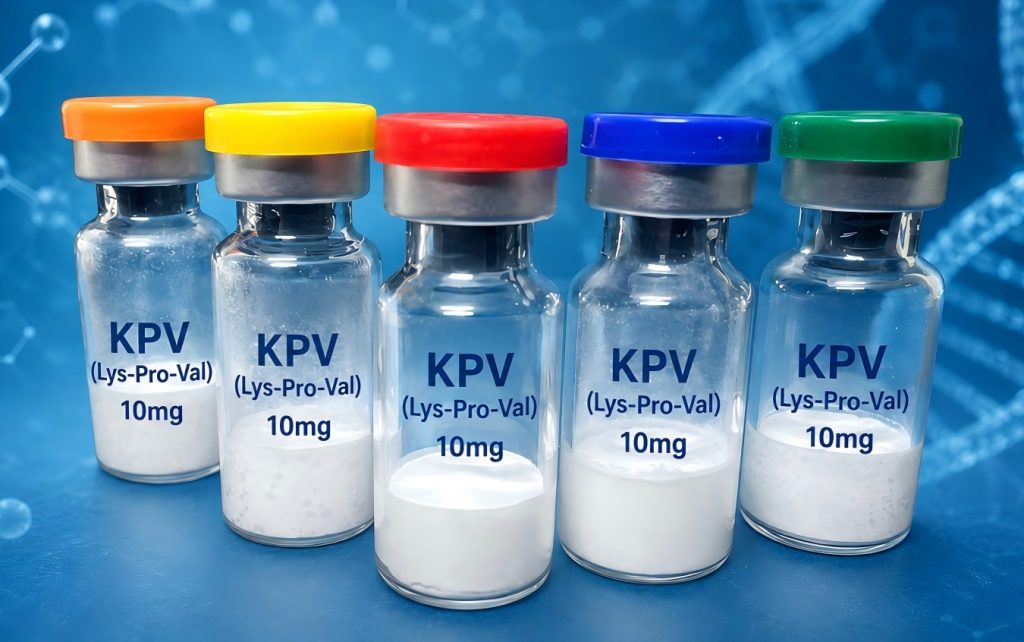
What Is KPV Peptide?
KPV, or Lys-Pro-Val, is a short tripeptide corresponding to the C-terminal three amino acids of alpha-melanocyte-stimulating hormone, commonly referred to as alpha-MSH.
Because KPV contains only three amino acids, its biological research profile is very different from that of full-length alpha-MSH.
SUNONE supplies research-grade KPV peptide, CAS 67727-97-3, for qualified laboratory, analytical and manufacturing research.
SUNONE KPV Product Page:
Why Is KPV Studied?
KPV is widely described online as an anti-inflammatory peptide, but that description alone misses an important part of the research story.
One of the best-characterized mechanisms involves PepT1, a transporter that carries small dipeptides and tripeptides into cells.
Published research has shown that KPV can be transported through PepT1 in intestinal epithelial and immune-cell models.
Once inside these cells, KPV has been associated with reduced activity in inflammatory signaling pathways including:
- NF-κB;
- MAP kinase pathways;
- pro-inflammatory cytokine production.
This makes KPV particularly interesting for mechanistic research involving epithelial biology and inflammatory signaling.
Why PepT1 Is Important
PepT1 is not simply another receptor.
It is a peptide transporter.
That distinction matters because KPV research may depend not only on receptor pharmacology but also on:
peptide uptake → intracellular transport → signaling effects.
In a foundational Gastroenterology study, KPV uptake through PepT1 was associated with inhibition of NF-κB and MAPK signaling in human intestinal cell lines.
The same study also observed reduced inflammation in mouse models of experimental colitis.
However, these findings remain preclinical evidence.
KPV Is Related to Alpha-MSH—but It Is Not the Same Molecule
KPV corresponds to the C-terminal Lys-Pro-Val sequence of alpha-MSH.
Alpha-MSH interacts with melanocortin receptors and has multiple biological effects.
KPV retains anti-inflammatory activity in several experimental models, but published research suggests that its signaling cannot simply be assumed to be identical to full-length alpha-MSH.
Research has proposed several mechanisms involving:
- PepT1-mediated transport;
- NF-κB inhibition;
- altered nuclear transport of inflammatory signaling proteins;
- context-dependent melanocortin-related activity.
Therefore:
KPV evidence should not automatically be interpreted as alpha-MSH evidence.

What Does Human Clinical Evidence Show?
This is the most important limitation in current KPV research.
As of 2026, FDA reported that it had not identified clinical studies or human exposure data for KPV through any route of administration.
That means there is currently no established human clinical evidence base for:
- efficacy;
- pharmacokinetics;
- validated dosing;
- long-term safety;
- immunogenicity.
Therefore:
cell and animal findings should not be presented as proven human therapeutic outcomes.
What Do Current KPV Reviews Say?
Current online KPV reviews are mixed.
Positive anecdotal reports sometimes mention:
- reduced perceived skin inflammation;
- improved gastrointestinal symptoms;
- improved comfort;
- reduced redness;
- general improvement in inflammation-related symptoms.
Other users report:
- no noticeable change;
- fatigue;
- headache or migraine;
- flu-like feelings;
- disturbed sleep;
- dry or irritated skin;
- redness or breakouts.
These reports come from uncontrolled online discussions.
The identity, purity, formulation and source of the products involved are generally unknown.
Therefore:
KPV reviews are anecdotal sentiment—not clinical evidence.
They also do not establish the safety, efficacy or quality of SUNONE Research Grade KPV.
Why KPV Material Identity Matters
KPV is chemically simple compared with many larger research peptides, but simple does not mean that analytical characterization is unnecessary.
Researchers should still confirm:
- Lys-Pro-Val sequence identity;
- peptide termini;
- molecular mass;
- HPLC purity;
- salt form where applicable;
- peptide-related impurities;
- batch consistency.
If experimental results are being interpreted through PepT1 transport or intracellular inflammatory signaling, incorrect peptide identity can undermine the entire experiment.
What Should Researchers Check When Choosing a KPV Supplier?
When comparing a research-grade KPV supplier, laboratories should look for clear molecular specifications and batch-specific analytical documentation.
SUNONE currently lists:
Product: KPV
Synonyms: KPV, Lys-Pro-Val, Lysyl-Prolyl-Valine, MSH (11-13)
CAS: 67727-97-3
Formula: C16H30N4O4
Molecular Weight: 342.43 g/mol
Sequence: Lys-Pro-Val
Grade: Research Grade
Form: Lyophilized Powder
Storage: 2–8°C, protect from light
Because website specifications may be updated, final purity, termini, salt form, storage conditions and analytical values should always be verified using the applicable batch-specific COA and SDS.
Final Thoughts
A common search question is:
“Is KPV an anti-inflammatory peptide?”
For researchers, a better question is:
“How is KPV transported into cells, and which signaling pathways are actually supported by experimental evidence?”
A stronger research framework is:
KPV identity → PepT1 transport → intracellular uptake → NF-κB/MAPK signaling → preclinical evidence → human evidence gap.
For laboratories comparing a KPV peptide supplier, accurate molecular identity and batch-specific analytical documentation should take priority over consumer testimonials or broad therapeutic claims.
SUNONE research peptide is for qualified labrtorynt, diagnois, druc tor mmatct or veteimant, use.research only, Not for human consumption, clinical treame.
Leave a Reply