
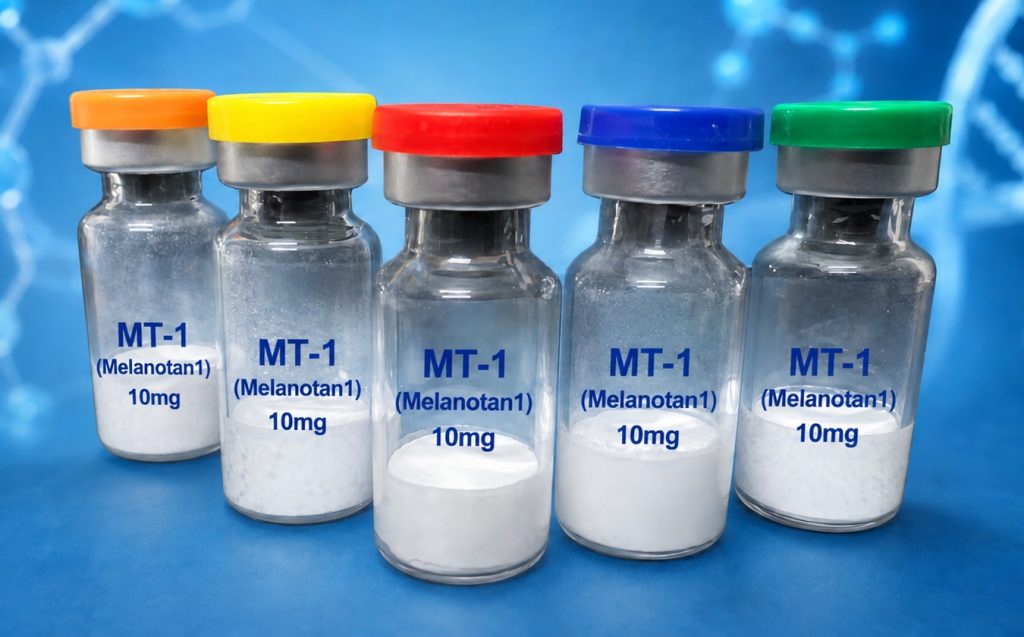
What Is Melanotan I?
Melanotan I (MT-1) is a synthetic analog of alpha-melanocyte-stimulating hormone, commonly abbreviated alpha-MSH.
It is also described in scientific literature as [Nle4, D-Phe7]-alpha-MSH or NDP-MSH.
SUNONE supplies research-grade Melanotan I for qualified laboratory, analytical and manufacturing research.
SUNONE Melanotan I Product Page:
Why Are Nle4 and D-Phe7 Important?
The most interesting feature of Melanotan I is not simply that it resembles alpha-MSH.
It contains two important amino-acid substitutions:
Position 4: Norleucine (Nle)
Position 7: D-Phenylalanine (D-Phe)
Early peptide research showed that these substitutions made the analog more resistant to enzymatic degradation and produced much more prolonged melanotropic activity than native alpha-MSH.
This is a useful example of an important peptide-engineering principle:
small sequence changes can produce major changes in stability and biological behavior.
Melanotan I Is Not Simply “Natural Alpha-MSH”
Native alpha-MSH is an endogenous signaling peptide.
Melanotan I is a synthetic analog designed to modify the properties of that native sequence.
Therefore, researchers should not automatically transfer data between:
- native alpha-MSH;
- Melanotan I / NDP-MSH;
- Melanotan II;
- approved afamelanotide pharmaceutical products.
These molecules may share melanocortin biology, but their molecular structures and research contexts are not identical.
What Did Early Melanotan I Research Show?
Classic laboratory studies described [Nle4, D-Phe7]-alpha-MSH as a potent and prolonged melanotropin.
Human research also demonstrated increased pigmentation and eumelanin under controlled investigational conditions.
However, these historical studies should be interpreted within their specific protocols and investigational materials.
They do not establish the safety or efficacy of unverified research products.

Is Melanotan I the Same as Afamelanotide?
The names are closely related in scientific literature, but researchers and buyers should be precise when discussing commercial materials.
Afamelanotide is the active substance in the approved pharmaceutical product SCENESSE.
In the United States, FDA approved SCENESSE for increasing pain-free light exposure in adults with erythropoietic protoporphyria (EPP). The European Medicines Agency also authorizes SCENESSE for adult EPP.
That regulatory approval applies to a specific pharmaceutical product with controlled manufacturing, formulation and clinical documentation.
It does not mean that every material marketed as “MT-1” or “Melanotan I” is an approved pharmaceutical product.
SUNONE Melanotan I is supplied as Research Grade material, not as SCENESSE.
What Do Current Melanotan I Reviews Say?
Current online Melanotan I reviews are mixed.
Positive anecdotal reports sometimes mention:
- visible pigmentation changes;
- more gradual pigmentation than MT-2;
- fewer perceived side effects than Melanotan II;
- satisfaction with skin-color changes.
Negative or neutral comments include:
- little or no noticeable change;
- nausea or gastrointestinal discomfort;
- fatigue;
- concern about mole or freckle darkening;
- uncertainty about long-term safety.
Recent community discussions also show substantial confusion between Melanotan I, Melanotan II and pharmaceutical afamelanotide.
These reviews are uncontrolled personal reports involving products of uncertain identity and quality.
Therefore:
Melanotan I reviews are anecdotal search sentiment—not clinical evidence.
They should not be interpreted as reviews of SUNONE Research Grade Melanotan I.
Why Molecular Identity Matters for MT-1 Research
When a research compound is defined by specific amino-acid substitutions, accurate identity becomes especially important.
Researchers may need to confirm:
- correct peptide sequence;
- Nle4 substitution;
- D-Phe7 stereochemistry;
- molecular mass;
- HPLC purity;
- peptide-related impurities;
- termini and chemical form;
- batch consistency.
A high purity number cannot compensate for the wrong sequence or stereochemistry.
For sequence-specific peptide research:
identity comes before purity.

What Should Researchers Check When Choosing a Melanotan I Supplier?
SUNONE currently lists:
Product: Melanotan I (MT-1)
Synonyms: Melanotan I, MT-1, Melanotan-1, Afamelanotide Research Analog, Alpha-MSH Analog
CAS: 75921-69-6
Formula: C78H111N21O19
Molecular Weight: 1646.9 g/mol
Purity: ≥99% HPLC
Form: Lyophilized Powder
Storage: 2–8°C, protect from light
Available Packs: 5 mg × 10 vials and 10 mg × 10 vials
Researchers should verify final identity, purity, stereochemistry and other analytical specifications using the applicable batch-specific COA, SDS and analytical documentation.
Final Thoughts
A common Google search asks:
“What is Melanotan I?”
For researchers, a more valuable question is:
“How do the Nle4 and D-Phe7 substitutions change the behavior of an alpha-MSH analog?”
That creates a stronger scientific framework:
native alpha-MSH → amino-acid substitution → enzymatic stability → melanocortin signaling → investigational evidence → pharmaceutical evidence → research-grade material identity.
For laboratories comparing a Melanotan I supplier, correct molecular identity, stereochemistry and batch-specific analytical documentation should take priority over consumer tanning claims.
SUNONE research peptide is for qualified labrtorynt, diagnois, druc tor mmatct or veteimant, use.research only, Not for human consumption, clinical treame.
Leave a Reply