
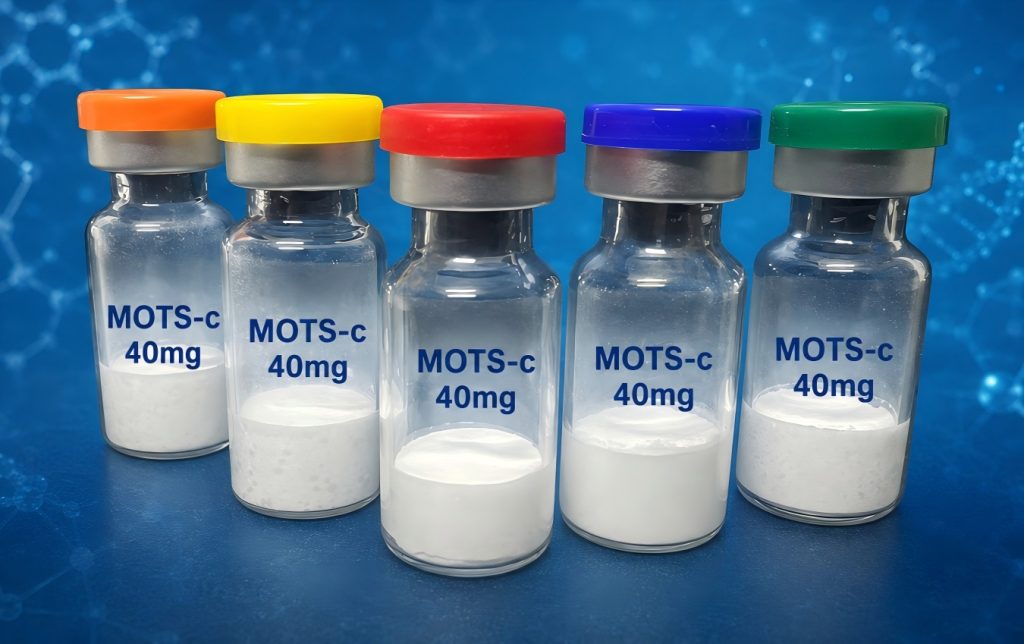
What Is MOTS-c?
MOTS-c is a mitochondrial-derived peptide encoded within a short open reading frame of mitochondrial 12S rRNA.
It is studied in research involving:
- mitochondrial signaling;
- cellular energy metabolism;
- metabolic adaptation;
- glucose utilization;
- stress-response pathways;
- skeletal-muscle biology.
SUNONE supplies research-grade MOTS-c, CAS 1627580-64-6, for qualified laboratory, analytical and manufacturing research.
SUNONE MOTS-c Product Page:
Why Is MOTS-c Associated With Exercise?
One influential human study found that exercise increased the body’s own endogenous MOTS-c.
In healthy young men, endogenous MOTS-c increased in skeletal muscle after exercise, while circulating MOTS-c also increased during and immediately after exercise before returning toward baseline.
This supports an important biological concept:
MOTS-c may participate in mitochondrial-to-cellular signaling during metabolic stress and exercise.
But there is an equally important limitation.
The study measured MOTS-c produced naturally by the human body.
It did not prove that administering synthetic MOTS-c produces the same effects in humans.
Endogenous MOTS-c and Exogenous MOTS-c Are Different Evidence Questions
This distinction is frequently lost in online MOTS-c content.
Researchers should separate:
Endogenous MOTS-c research
Measures naturally occurring MOTS-c in blood, muscle or other tissues.
Exogenous MOTS-c research
Tests what happens when manufactured MOTS-c is introduced experimentally.
Finding that endogenous MOTS-c rises after exercise does not automatically establish that synthetic MOTS-c improves human exercise capacity.
A biomarker can be associated with a biological process without becoming a proven therapeutic intervention.
What Do Human MOTS-c Studies Actually Show?
Human research has found associations between circulating MOTS-c and several metabolic states.
A systematic review and meta-analysis involving 602 participants examined circulating mitochondrial-derived peptides across obesity and diabetes studies.
The results were not completely uniform.
Circulating MOTS-c tended to be lower in people with diabetes, while the obesity subgroup showed a different direction of association.
This heterogeneity matters.
It suggests that MOTS-c biology may be more complex than the simple idea:
“more MOTS-c = better metabolism.”

What About Exogenous MOTS-c Clinical Trials?
As of 2026, the human interventional evidence remains very limited.
A registered Phase 2 study, NCT07505745, is currently evaluating investigational MOTS-c in adults with prediabetes and overweight or obesity.
The study is recruiting and has not posted results.
Therefore, there is currently no completed result from this trial demonstrating human efficacy or establishing a complete safety profile.
This means claims about exogenous MOTS-c should still be separated from the much larger body of cell, animal and observational human research.
What Does Preclinical MOTS-c Research Suggest?
Experimental research has investigated MOTS-c in areas including:
- AMPK signaling;
- insulin sensitivity;
- metabolic homeostasis;
- skeletal-muscle adaptation;
- nuclear stress-response signaling;
- age-related physical decline.
Animal studies have reported improved physical performance and metabolic outcomes under specific experimental conditions.
These results are scientifically interesting.
However:
mouse performance data are not human clinical efficacy data.
What Do Current MOTS-c Reviews Say?
Current online MOTS-c reviews are highly mixed.
Positive anecdotal reports sometimes mention:
- increased perceived energy;
- better exercise endurance;
- improved workout performance;
- improved mental alertness.
Negative or neutral reports include:
- no noticeable effect;
- severe fatigue;
- brain fog;
- nausea;
- body aches;
- injection-site reactions;
- allergy-like reactions.
Some users report that their experience changed dramatically from one day to another.
This variability is important because online reports may involve:
- unidentified peptide sources;
- different formulations;
- multiple compounds used simultaneously;
- different health conditions;
- uncontrolled lifestyle variables.
Therefore:
MOTS-c reviews are anecdotal search sentiment—not controlled evidence of efficacy or safety.
They should not be interpreted as reviews of SUNONE Research Grade MOTS-c.

Why This Evidence Boundary Matters for Researchers
The most useful scientific question is not simply:
“Does MOTS-c increase energy?”
A better question is:
“Which findings concern naturally produced human MOTS-c, and which findings concern externally administered synthetic MOTS-c?”
That distinction prevents evidence from being transferred across fundamentally different experimental conditions.
A strong evidence hierarchy is:
endogenous human biomarker → observational association → cell studies → animal intervention → human interventional trial.
Each level answers a different question.
What Should Researchers Check When Choosing a MOTS-c Supplier?
For laboratory research, accurate material characterization is essential.
SUNONE currently lists:
Product: MOTS-c
Synonyms: MOTS-c, MOTS-c (Human), Mitochondrial Open Reading Frame of the 12S rRNA-c
CAS: 1627580-64-6
Formula: C101H152N28O22S2
Molecular Weight: 2174.6 g/mol
Form: Lyophilized Powder
Grade: Research Grade
Storage: 2–8°C, protect from light
Because online specifications may change, researchers should verify final sequence identity, termini, salt form, purity, storage conditions and analytical results using the applicable batch-specific COA and SDS.
Final Thoughts
MOTS-c is one of the more interesting examples of mitochondrial-derived peptide research because it connects mitochondrial genetics, cellular stress signaling and exercise biology.
But the strongest current human evidence largely concerns endogenous MOTS-c.
That is not the same as proving the effects of exogenous synthetic MOTS-c.
For laboratories comparing a MOTS-c supplier, the appropriate research framework is:
molecular identity → mitochondrial signaling → endogenous human evidence → preclinical intervention data → human clinical evidence gap → batch-specific analytical quality.
Keeping these evidence levels separate produces more reproducible research and more scientifically accurate interpretation.
SUNONE research peptide is for qualified labrtorynt, diagnois, druc tor mmatct or veteimant, use.research only, Not for human consumption, clinical treame.
Leave a Reply