
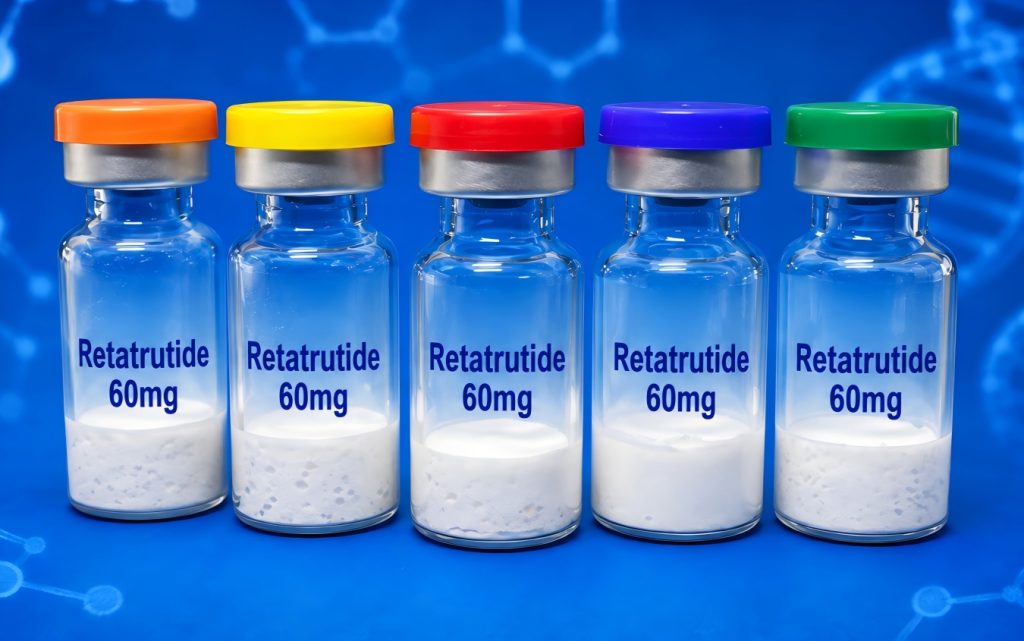
What Is Retatrutide?
Retatrutide, also known as LY3437943, is an investigational peptide designed to activate three metabolically relevant receptors:
GIP receptor — GIPR
GLP-1 receptor — GLP-1R
Glucagon receptor — GCGR
SUNONE supplies research-grade Retatrutide, CAS 2381089-83-2, for qualified laboratory, analytical and manufacturing research.
SUNONE Retatrutide Product Page:
Why “Triple Agonist” Does Not Tell the Whole Story
Retatrutide is commonly described online as a:
“GIP + GLP-1 + glucagon triple agonist.”
That description is correct, but incomplete.
A three-receptor peptide does not necessarily activate all three receptors with identical potency.
Published Retatrutide pharmacology found that LY3437943 showed relatively balanced activity at GLP-1R and GCGR, while displaying greater activity at GIPR.
Therefore, a better research framework is:
three receptors → relative receptor potency → signaling balance → biological outcome.
Simply counting receptors does not explain the molecule.
Why Does Receptor Balance Matter?
Each receptor contributes different biological signals.
GIPR
GIP receptor signaling is associated with incretin biology and glucose-dependent metabolic regulation.
GLP-1R
GLP-1 receptor signaling is strongly associated with glucose regulation, satiety-related pathways and reduced energy intake.
GCGR
Glucagon receptor signaling introduces a different metabolic dimension and has been investigated for its influence on hepatic metabolism and energy expenditure.
The original Retatrutide development research suggested that glucagon-receptor activity could add energy-expenditure effects to the calorie-intake effects generated through the incretin pathways.
This is why Retatrutide research is better described as multi-receptor balance rather than simply “three hormones in one peptide.”
What Does the 2026 Phase 3 Evidence Show?
Retatrutide has now generated substantial Phase 3 clinical evidence.
In TRIUMPH-1, Lilly reported average body-weight reduction of up to 28.3% at 80 weeks, with continued reduction in an extension population.
Additional 2026 Phase 3 topline results showed average reductions of up to approximately:
20.8% in TRIUMPH-2
and
22.6% in TRIUMPH-3.
These results strengthen the clinical evidence for the investigational pharmaceutical program.
However, an important distinction remains:
clinical-trial Retatrutide ≠ research-grade Retatrutide material.
Clinical trial results do not establish the safety, efficacy or pharmaceutical equivalence of SUNONE Research Grade Retatrutide.

Is Retatrutide FDA Approved?
As of September 2026, Retatrutide has not been approved by FDA or any other regulatory agency.
Eli Lilly continues to describe Retatrutide as an investigational medicine.
The company has stated that it plans to submit a U.S. regulatory application in 2027.
This regulatory distinction matters because search results frequently mix:
- clinical trial information;
- research peptides;
- unofficial online products;
- approved GLP-1 medicines.
Researchers should keep these categories separate.
What Do Retatrutide Reviews Say?
Current online Retatrutide reviews are highly mixed.
Positive anecdotal reports frequently mention:
- strong appetite suppression;
- earlier fullness;
- perceived weight reduction;
- relatively mild side effects in some users.
Negative reports include:
- nausea;
- constipation;
- diarrhea or gastrointestinal discomfort;
- increased heart rate;
- fatigue;
- poor sleep;
- food aversion;
- reduced motivation or emotional flatness.
These reports are uncontrolled and often involve products obtained outside regulated clinical trials.
Therefore:
Retatrutide reviews are anecdotal search sentiment—not controlled clinical evidence.
They should not be treated as evidence for SUNONE Research Grade Retatrutide.
Why Research Material Identity Matters
Retatrutide is a modified synthetic peptide with a complex molecular identity.
For research applications, laboratories should consider more than the marketing term “triple agonist.”
Important quality attributes may include:
- correct molecular identity;
- exact chemical form;
- salt state where applicable;
- molecular mass;
- HPLC purity;
- peptide-related impurities;
- batch consistency;
- analytical documentation.
SUNONE specifically recommends verifying exact chemical form, purity and related specifications using the applicable batch-specific COA.

What Should Researchers Check When Choosing a Retatrutide Supplier?
When evaluating a research-grade Retatrutide supplier, laboratories should prioritize analytical transparency.
SUNONE currently lists:
Product: Retatrutide
Synonyms: LY3437943, LY-3437943
CAS: 2381089-83-2
Formula: C221H342N46O68
Molecular Weight: approximately 4731 g/mol
Purity: ≥99.6% by HPLC
Grade: Research Grade
Form: Lyophilized Powder
Storage: 2–8°C
Exact chemical form, salt state, identity and purity should be verified against the batch-specific Certificate of Analysis (COA).
Final Thoughts
A common Google search asks:
“Why is Retatrutide stronger than a GLP-1?”
For researchers, a more precise question is:
“How does the balance of GIPR, GLP-1R and GCGR activity shape Retatrutide pharmacology?”
A stronger scientific framework is:
molecular identity → receptor potency → GIPR / GLP-1R / GCGR balance → downstream signaling → experimental interpretation.
For laboratories comparing a Retatrutide supplier, correct peptide identity, HPLC purity, chemical-form verification and batch-specific documentation should take priority over consumer-facing weight-loss claims.
SUNONE research peptide is for qualified labrtorynt, diagnois, druc tor mmatct or veteimant, use.research only, Not for human consumption, clinical treame.
Leave a Reply