
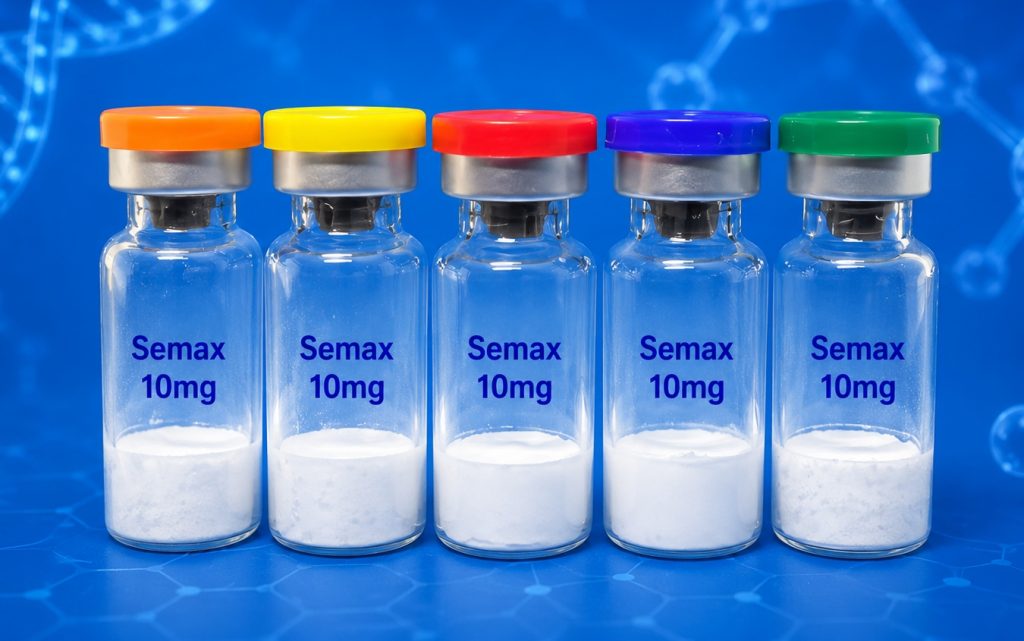
What Is Semax?
Semax is a synthetic heptapeptide derived from the ACTH peptide system and widely studied in neuroscience-related experimental models.
The commonly described sequence is:
Met-Glu-His-Phe-Pro-Gly-Pro
Semax combines an ACTH(4-7)-derived sequence with a C-terminal Pro-Gly-Pro, or PGP, segment.
SUNONE supplies research-grade Semax, CAS 80714-61-0, for qualified laboratory, analytical and manufacturing research.
SUNONE Semax Product Page:
Why Does the PGP Tail Matter?
Semax is sometimes described simply as an ACTH(4-7) analogue.
That description is incomplete.
The molecule also contains the sequence:
Pro-Gly-Pro
at its C-terminus.
Published experimental research has shown that both Semax and PGP can influence neurotrophin-related gene expression in animal models.
This means the PGP segment may contribute to the biological profile of the complete peptide.
A more useful research framework is:
ACTH fragment → PGP extension → complete Semax sequence → molecular signaling.
What Does Semax Research Say About BDNF?
One of the most frequently discussed Semax research areas involves:
BDNF — brain-derived neurotrophic factor
and
NGF — nerve growth factor.
Animal studies have reported changes in Bdnf and Ngf expression following Semax exposure.
However, the effects were dynamic and tissue-dependent rather than a simple permanent “BDNF increase.”
For example, experimental studies reported different timing patterns between the hippocampus and frontal cortex.
Therefore:
Semax → BDNF research
does not mean
Semax → proven cognitive enhancement in humans.
Mechanistic evidence and clinical evidence should remain separate.
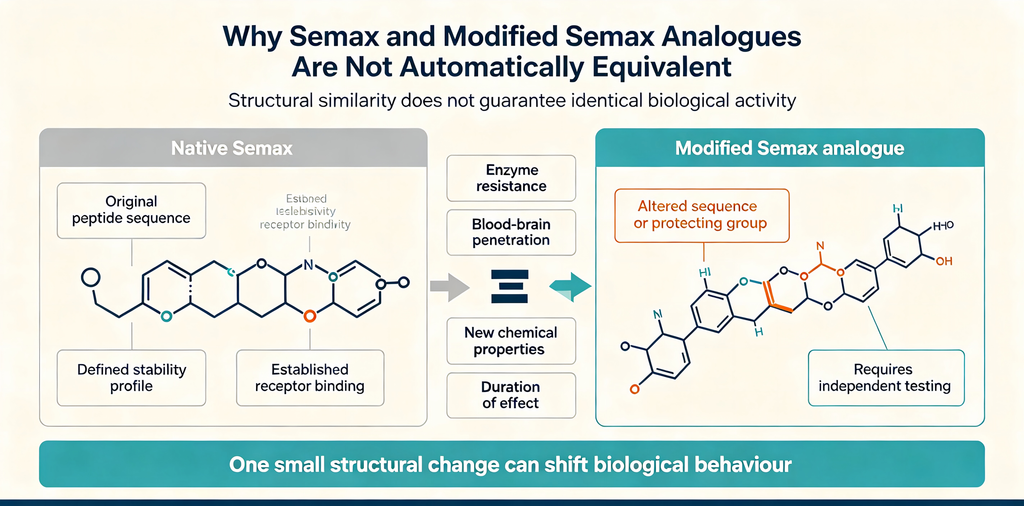
Why Semax and Modified Semax Analogues Are Not Automatically Equivalent
Online discussions increasingly use names such as:
- Semax;
- N-acetyl Semax;
- Semax amidate;
- Semax acetate;
- modified Semax.
These names should not automatically be treated as interchangeable.
Changing terminal chemistry, salt form or sequence modification can affect:
- molecular mass;
- stability;
- analytical identity;
- degradation behavior;
- receptor or enzyme interactions.
Evidence generated using standard Semax should therefore not automatically be assigned to another modified analogue.
For peptide researchers:
same marketing name ≠ same molecular identity.
FDA Has Highlighted This Identity Problem
In 2026, FDA reviewed Semax free base and Semax acetate in the context of compounded-drug bulk substances.
FDA noted that the name “Semax” has been used commercially for different salts and derivatives.
This creates a practical analytical problem:
If the material identity is unclear, laboratories may not know whether a reference standard and a research sample represent the same chemical substance.
This makes:
exact molecular identity + batch-specific COA
particularly important for Semax research.
What Do Current Semax Reviews Say?
Current online Semax reviews are highly mixed.
Positive anecdotal reports sometimes mention:
- increased perceived focus;
- improved verbal fluency;
- improved mental clarity;
- increased productivity;
- improved subjective motivation.
Negative or neutral reports include:
- no noticeable effect;
- fatigue or sleepiness;
- headache;
- nausea;
- increased anxiety;
- irritability;
- worsening brain fog.
Some users also discuss Semax together with Selank, stimulants or other compounds, making attribution even more difficult.
Therefore:
Semax reviews represent anecdotal user sentiment—not controlled scientific evidence.

Why Online Semax Claims Should Be Interpreted Carefully
Semax is frequently marketed online using phrases such as:
“focus peptide”
“BDNF peptide”
or
“nootropic peptide.”
These phrases simplify a much more complex evidence base.
Most mechanistic findings involve:
- animal models;
- cellular models;
- gene-expression experiments;
- relatively old and limited human literature.
This does not justify automatically converting mechanistic research into broad clinical-performance claims.
What Should Researchers Check When Choosing a Semax Supplier?
When evaluating a research-grade Semax supplier, laboratories should prioritize molecular identity and batch documentation.
SUNONE currently lists:
Product: Semax
Synonym: ACTH(4-7) analog, heptapeptide
CAS: 80714-61-0
Formula: C37H51N9O10S
Molecular Weight: 813.90 g/mol
Purity: ≥98% by HPLC
Form: Lyophilized Solid
Grade: Research / HPLC
Storage: -20°C
Relevant COA, SDS and analytical documentation should be reviewed for the specific batch.
Final Thoughts
A common Google search asks:
“Does Semax increase BDNF?”
For researchers, a better question is:
“Which Semax molecular form was tested, and how does its ACTH(4-7)-PGP structure affect the interpretation?”
A stronger research framework is:
sequence → PGP tail → chemical form → molecular identity → neurotrophin signaling → experimental interpretation.
For laboratories comparing a Semax supplier, correct identity, HPLC purity, chemical-form verification and batch-specific analytical documentation should take priority over consumer-facing cognitive or performance claims.
SUNONE research peptide is for qualified labrtorynt, diagnois, druc tor mmatct or veteimant, use.research only, Not for human consumption, clinical treame.
Leave a Reply