
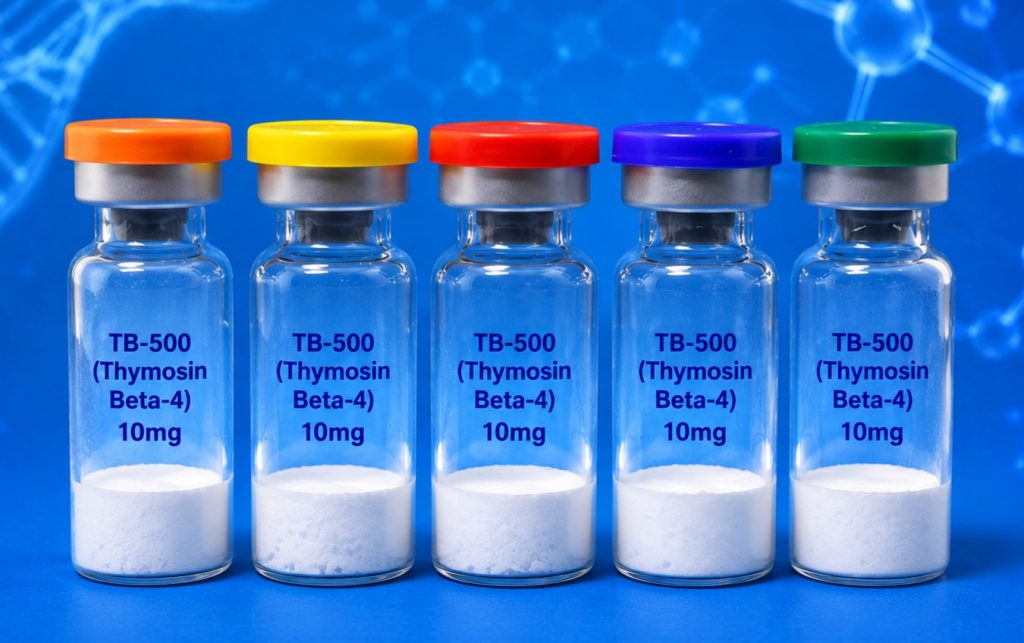
What Is TB-500?
TB-500 is a synthetic N-terminally acetylated heptapeptide with the sequence:
Ac-LKKTETQ
It corresponds to amino-acid residues 17–23 of human thymosin β4 (Tβ4).
SUNONE supplies research-grade TB-500 for qualified laboratory, analytical and manufacturing research.
SUNONE TB-500 Product Page:
TB-500 Is Not Full-Length Thymosin β4
This is one of the most important distinctions in TB-500 research.
Full-length thymosin β4 contains 43 amino acids.
TB-500 contains only a short seven-amino-acid region derived from that sequence.
The two materials are therefore not molecularly identical.
This matters because a biological effect observed with full-length thymosin β4 cannot automatically be assigned to TB-500.
A more accurate evidence framework is:
full-length Tβ4 evidence ≠ TB-500 fragment evidence.
Why Is the LKKTETQ Region Important?
The LKKTETQ region lies within an important actin-associated domain of thymosin β4.
Research involving this region has explored:
- actin-related biology;
- cell migration;
- cytoskeletal regulation;
- wound-healing models;
- angiogenesis-related pathways;
- fibrotic signaling.
Older mechanistic studies show that residues around the 17–23 region contribute to thymosin β4 interaction with actin.
However, full-length Tβ4 contains additional structural and functional regions.
That means the fragment may reproduce some local sequence-associated biology without reproducing every property of the intact molecule.
What Does the 2026 Evidence Review Show?
A 2026 scoping review examined the literature on thymosin β4 and TB-500 in tissue healing and musculoskeletal research.
The review included 80 studies.
Its most important finding for researchers was not simply that repair-related pathways were reported.
It was that:
most studies evaluated full-length thymosin β4 rather than TB-500.
Direct TB-500 evidence was extremely limited.
Human evidence was also concentrated mainly in ocular, corneal, skin and soft-tissue research, while direct human evidence relevant to tendon, ligament, muscle and other musculoskeletal applications remained sparse.
This is important because online TB-500 marketing often presents the larger thymosin β4 literature as though it were direct TB-500 evidence.
Scientifically, that is not the same thing.

Why Analytical Identity Matters
TB-500 has been analytically identified as the N-acetylated thymosin β4 17–23 fragment, Ac-LKKTETQ.
For laboratory research, researchers should therefore verify:
- correct seven-amino-acid sequence;
- N-terminal acetylation;
- molecular mass;
- HPLC purity;
- peptide-related impurities;
- salt or chemical form;
- batch consistency.
A label that simply says “Thymosin Beta-4” is not sufficient to prove that the material is TB-500.
Likewise, a TB-500 fragment should not automatically be treated as full-length thymosin β4.
What Do Current TB-500 Reviews Say?
Current online TB-500 reviews are mixed.
Positive anecdotal reports sometimes mention:
- improved perceived recovery;
- reduced joint discomfort;
- reduced inflammation;
- improved mobility;
- faster return to normal activity.
Negative reports include:
- fatigue;
- brain fog;
- emotional numbness;
- headache;
- dizziness;
- feeling generally unwell;
- no noticeable benefit.
Many posts involve TB-500 combined with BPC-157 or other compounds, making attribution especially difficult.
Product identity and analytical quality are also usually unknown.
Therefore:
TB-500 reviews are anecdotal search sentiment—not controlled clinical evidence.
They should not be interpreted as reviews of SUNONE Research Grade TB-500.
What Does FDA Say About TB-500?
FDA has stated that it has not identified human exposure data for drug products containing the thymosin β4 fragment known as TB-500.
The agency has also highlighted potential concerns involving:
- peptide aggregation;
- peptide-related impurities;
- API characterization;
- immunogenicity.
This reinforces an important research principle:
preclinical biological plausibility is not the same as established human safety or efficacy.

What Should Researchers Check When Choosing a TB-500 Supplier?
SUNONE currently lists:
Product: TB-500
Sequence: Ac-LKKTETQ
Synonyms: TB500, N-acetyl-LKKTETQ, Thymosin β4 Fragment 17–23
CAS: 885340-08-9
Formula: C38H68N10O14
Molecular Weight: 889.0 g/mol
Purity: ≥99.1% HPLC
Form: Lyophilized Peptide
Grade: Research / HPLC
Storage: -20°C
Final identity, purity, chemical form, storage conditions and analytical results should always be verified using the applicable batch-specific COA, HPLC, MS and SDS documentation.
Final Thoughts
A common search asks:
“What does TB-500 do?”
For researchers, a more important question is:
“Was the published experiment actually performed with TB-500, or with full-length thymosin β4?”
That distinction creates a stronger scientific framework:
sequence identity → fragment vs full-length molecule → actin-associated biology → preclinical evidence → human evidence gap → analytical verification.
For laboratories comparing a TB-500 supplier, correct Ac-LKKTETQ identity and batch-specific analytical documentation should take priority over broad “healing peptide” claims.
SUNONE research peptide is for qualified labrtorynt, diagnois, druc tor mmatct or veteimant, use.research only, Not for human consumption, clinical treame.
Leave a Reply