
Four Peptides in One Vial Sounds Convenient. Analytically, It Is More Complicated.
KLOW peptide blends have become increasingly visible in peptide research discussions.
Typically, the name refers to a multi-component formulation combining:
GHK-Cu + BPC-157 + TB-500 + KPV.
Each component is associated with a different area of biological research.
But that creates an important procurement question:
If four research compounds are present in one vial, can the supplier prove the identity and specification of all four?
For professional laboratories, that question matters more than the blend’s popularity.
What Is the KLOW Peptide Blend?
KLOW is commonly described as an extension of the three-component “GLOW” concept, with KPV added to a formulation containing GHK-Cu, BPC-157 and TB-500.
The four components are researched in different biological contexts:
- GHK-Cu — copper-peptide signaling, extracellular-matrix biology and tissue-remodeling research;
- BPC-157 — regenerative and tissue-related pathway research;
- TB-500 — actin-associated and cellular-migration research;
- KPV — inflammatory-signaling and epithelial-biology research.
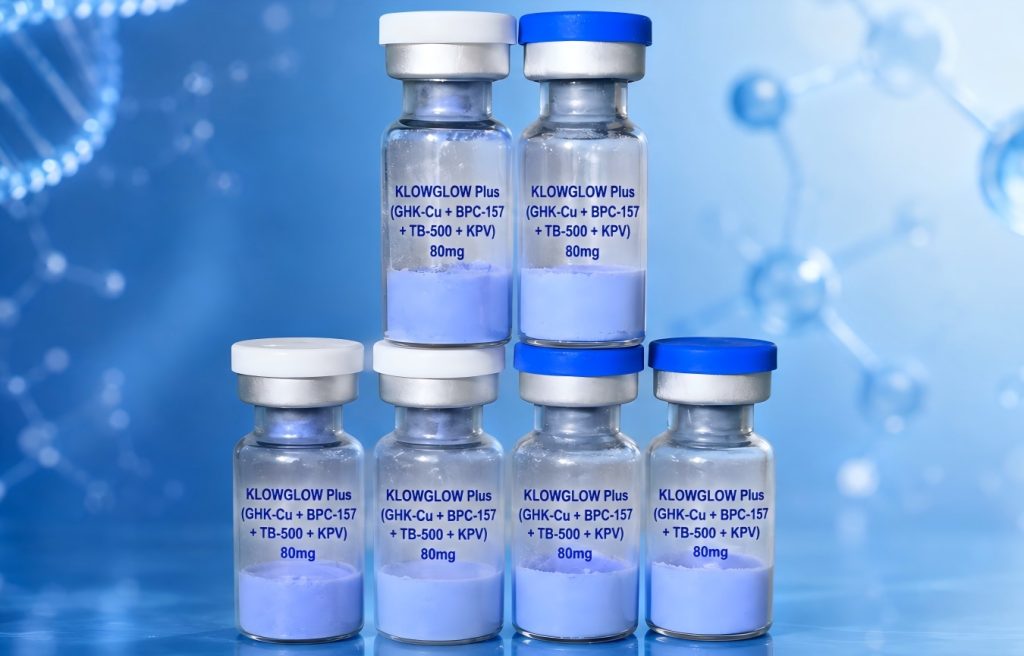
SUNONE supplies this combination as KLOWGLOW Plus, a multi-component research formulation.
Why Has KLOW Attracted So Much Attention?
The scientific logic is easy to understand.
GHK-Cu has a substantial history in tissue-remodeling and skin-related research. Published reviews discuss effects on collagen-related pathways, fibroblast biology and extracellular-matrix signaling, while also noting limitations in the available clinical evidence.
KPV has demonstrated anti-inflammatory signaling effects in experimental cellular and mouse models.
BPC-157 and thymosin-related molecules also have extensive preclinical literature in tissue and regenerative research.
That creates an attractive hypothesis:
Could multiple research pathways be studied together in one formulation?
It is an interesting research question.
It is not the same as proven clinical synergy.

The Biggest Evidence Gap: The Blend Is Not the Same as Its Ingredients
This distinction is easy to miss in online content.
A study on GHK-Cu does not prove the effectiveness of KLOW.
A study on KPV does not establish the behavior of a four-component blend.
A study involving thymosin β4 should not automatically be attributed to every material sold as TB-500.
Current online discussions themselves acknowledge that the published evidence largely comes from individual components rather than the exact GHK-Cu + BPC-157 + TB-500 + KPV formulation.
For scientific accuracy:
component evidence should remain component evidence.
More Components Mean More Quality Questions
A single research peptide already requires identity and purity verification.
A four-component peptide blend creates additional variables.
Professional buyers should ask:
- Is each component individually identified?
- What quantity of each component is present?
- What is the actual component ratio?
- What chemical or salt form applies to each ingredient?
- Can analytical testing distinguish the individual components?
- Is the stated purity an aggregate number or component-specific?
- Does the COA correspond to the actual production lot?
This matters because one headline purity figure may not provide enough information about every component in a multi-component formulation.
For a blend:
“99%+ purity” should not be the end of the quality discussion.
Positive and Negative Reviews Point to the Same Issue
Online KLOW discussions include users reporting perceived changes in skin appearance, inflammation or recovery.
Other users report minimal effects, formulation questions or adverse reactions involving related peptide blends.
These anecdotes cannot establish efficacy or causality.
But they do highlight why professional procurement should focus on:
identity, composition, traceability and analytical documentation.
A blend is only useful for controlled research when the researcher knows what the blend actually contains.

SUNONE KLOWGLOW Plus Research Blend
SUNONE supplies KLOWGLOW Plus (GHK-Cu + BPC-157 + TB-500 + KPV) for qualified laboratory and manufacturing applications.
Current product information lists:
- four-component research formulation;
- GHK-Cu + BPC-157 + TB-500 + KPV;
- 80 mg total research blend;
- ≥99.6% Research Grade;
- lyophilized powder;
- batch-specific COA;
- SDS;
- Specification Sheet;
- made-to-order B2B supply.
Because it is a multi-component formulation, SUNONE specifies that the exact identity, amount, ratio, salt form and analytical specifications should be verified against the applicable batch-specific documentation.
Looking for a KLOW Peptide Blend Supplier?
For biotechnology companies, laboratories and research distributors, buying a peptide blend should involve more—not less—documentation.
If your organization is evaluating:
KLOW peptide, KLOWGLOW Plus, GHK-Cu BPC-157 TB-500 KPV blend, or multi-component regenerative research peptides,
request information on:
component identity, ratio, purity, analytical methods, COA, packaging, MOQ and repeat-batch supply.
Conclusion
KLOW is interesting because it combines four biologically distinct research compounds.
That is also exactly why it requires careful characterization.
For professional research procurement, the question should not simply be:
“How many peptides are in the vial?”
It should be:
“Can the analytical documentation verify each component in that vial?”
With multi-component peptide research, complexity makes transparency more valuable.
This content is provided for scientific and educational purposes only. SUNONE research peptide is for qualified labrtorynt, diagnois, druc tor mmatct or veteimant, use.research only, Not for human consumption, clinical treame. Purchasers are responsible for complying with applicable laws and regulations in their jurisdiction.
Leave a Reply