
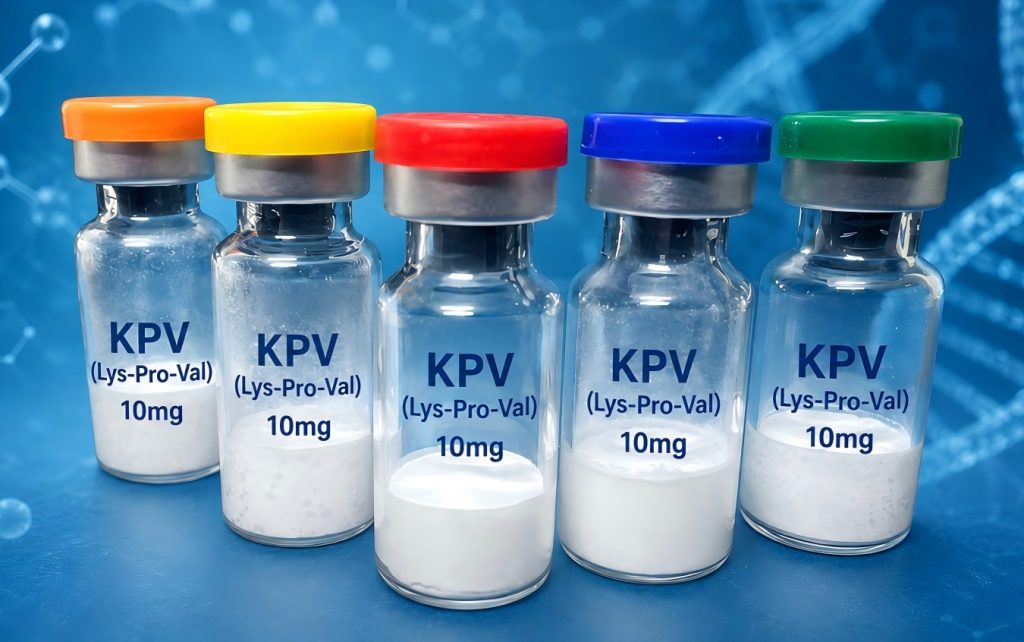
KPV Has Only Three Amino Acids. The Research Story Is Much Bigger.
KPV looks unusually simple.
Lys-Pro-Val. Three amino acids.
Also known as Lys-Pro-Val peptide, MSH (11–13), or KPV tripeptide, it corresponds to a short C-terminal fragment associated with α-melanocyte-stimulating hormone research.
Yet this small peptide has generated growing interest in:
inflammatory signaling, epithelial biology, intestinal research, skin models and tissue-response pathways.
That simplicity can create the wrong procurement assumption:
“If the peptide is only three amino acids long, identity should be easy.”
For professional research, it still needs to be verified.
Why Are Researchers Interested in KPV?
One of the best-known KPV studies investigated its interaction with PepT1, a di- and tripeptide transporter.
Researchers reported that KPV reduced NF-κB and MAPK inflammatory signaling in experimental intestinal and immune-cell models. In mouse colitis models, KPV was also associated with reduced inflammatory markers.
More recent studies have investigated KPV in human keratinocyte models exposed to particulate-matter-induced oxidative stress and in experimental lipid-metabolism models.
This makes KPV peptide research scientifically interesting.
But it does not make KPV a clinically proven treatment.

Preclinical Evidence Is Not Human Clinical Evidence
This distinction matters because Google searches for KPV increasingly contain claims about:
gut healing, inflammation, skin conditions, wound healing and other health outcomes.
The evidence is much narrower.
FDA’s 2026 scientific review described KPV as a synthetic Lys-Pro-Val tripeptide with nonclinical anti-inflammatory activity, including possible inhibition of NF-κB-related signaling. FDA also noted that the molecular targets remain incompletely defined.
More importantly, FDA concluded that human safety information for KPV free base and KPV acetate remains lacking and that potential risks in humans are not adequately characterized.
So responsible research content should say:
KPV has interesting preclinical anti-inflammatory biology.
It should not say:
KPV is clinically proven to treat inflammatory disease.
What About the 2026 FDA Committee Vote?
KPV received new attention in July 2026 when the FDA Pharmacy Compounding Advisory Committee considered KPV free base and KPV acetate for the 503A Bulks List.
The advisory panel voted 8–6, with one abstention, in favor of recommending the substances.
That result requires careful interpretation.
An advisory-committee recommendation is not FDA drug approval.
It also does not establish clinical efficacy, pharmaceutical equivalence or long-term safety.
For B2B research procurement, however, the discussion highlights an important point:
free base and acetate form should not automatically be treated as meaningless details.
Positive and Negative KPV Reviews Are Highly Mixed
Current community discussions illustrate how unreliable anecdotal evidence can be.
Some users describe perceived improvements involving skin or inflammatory symptoms.
Others report no noticeable change at all.
Recent discussions also contain negative reports involving facial redness, dry skin and eczema-like reactions.
These reports cannot establish that KPV caused either the positive or negative outcomes.
They reinforce a better research question:
Was the material correctly identified, characterized and linked to the correct batch documentation?
What Should a Professional KPV Buyer Verify?
For laboratories sourcing KPV peptide, the product name alone is not sufficient.
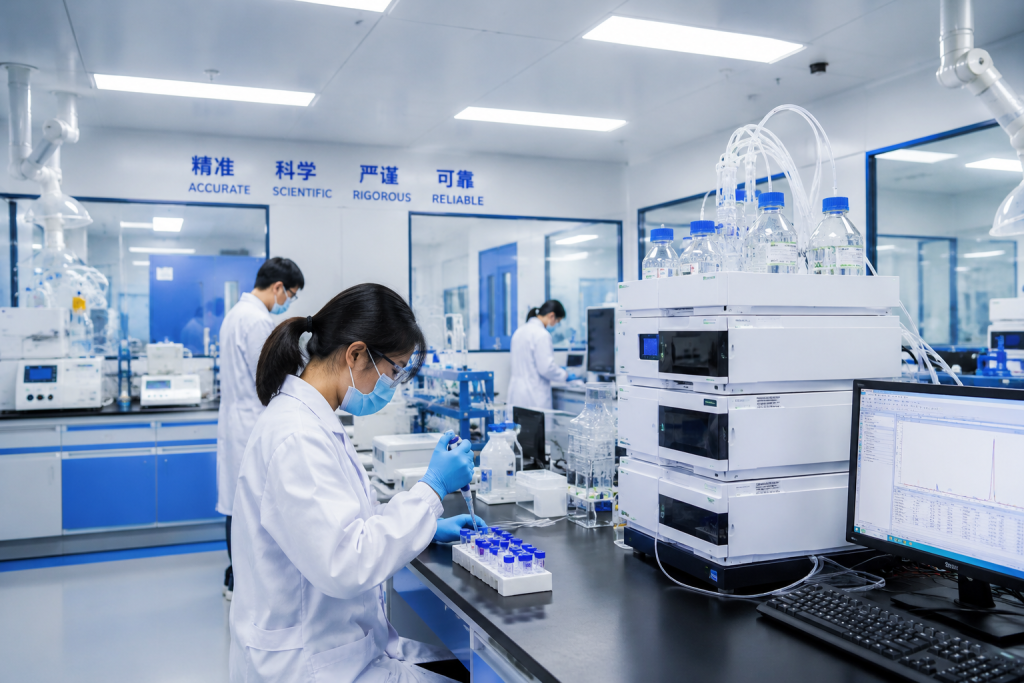
Researchers should verify the exact Lys-Pro-Val identity, peptide termini, free-base or salt form where relevant, batch-specific purity, analytical data, storage specifications and lot traceability.
Analytical methods matter as well. Published work has specifically developed stability-indicating HPLC methodology for KPV, demonstrating that chromatographic identity, degradation and quantitative analysis can be evaluated rather than assumed.
For such a short peptide:
simple sequence does not eliminate the need for serious documentation.
SUNONE KPV Research Peptide
SUNONE supplies KPV / Lys-Pro-Val research peptide for qualified laboratory and manufacturing applications.
Current product information identifies:
KPV / Lys-Pro-Val / MSH (11–13)
CAS 67727-97-3
Molecular formula C16H30N4O4
Molecular weight 342.43 g/mol
Lyophilized Research Grade material
5 mg and 10 mg B2B configurations
Certificate of Analysis
Safety Data Sheet
Specification Sheet
SUNONE specifies that final identity, termini, salt form, purity and analytical characteristics should be confirmed against the applicable batch-specific COA.
View SUNONE KPV Specifications :
Looking for a KPV Peptide Supplier with COA?
For peptide laboratories, biotechnology companies and research distributors, the purchasing question should not simply be:
“How pure is the KPV?”
A stronger question is:
“Can the supplier document exactly which KPV material this batch contains?”
If your organization is sourcing KPV peptide, Lys-Pro-Val, KPV research peptide, or other inflammation and epithelial-biology research peptides, SUNONE can provide current specifications, batch documentation, MOQ, packaging and quotation information.
Request KPV COA, Specifications & B2B Quote from SUNONE:
Conclusion
KPV demonstrates why peptide research cannot be judged by molecular size alone.
Three amino acids can still raise meaningful questions about:
identity, chemical form, purity, stability and experimental interpretation.
The preclinical biology is interesting.
The human evidence remains limited.
For professional research procurement, that leads to one practical principle:
Keep the claims conservative—and make the analytical documentation strong.
This content is provided for scientific and educational purposes only. SUNONE research peptide is for qualified labrtorynt, diagnois, druc tor mmatct or veteimant, use.research only, Not for human consumption, clinical treame. Purchasers are responsible for complying with applicable laws and regulations in their jurisdiction.
Leave a Reply