
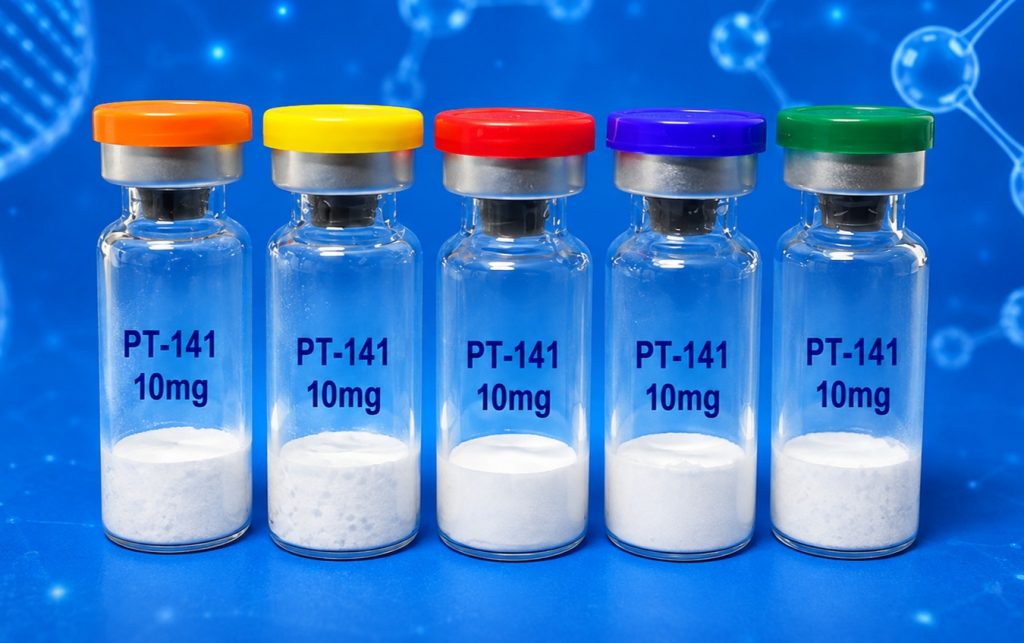
PT-141 Is Not Just Another “Trending Peptide”
Search for PT-141, and you will find everything from clinical studies to dramatic online testimonials.
Also known as Bremelanotide, PT-141 is a synthetic cyclic heptapeptide and melanocortin receptor agonist.
Unlike many research peptides circulating online, bremelanotide also has an established pharmaceutical-development history.
That makes one distinction especially important:
An FDA-approved bremelanotide medicine and a research-grade PT-141 material may share a molecular name, but they are not automatically equivalent products.
What Is PT-141 Bremelanotide?
PT-141 is a cyclic melanocortin-related peptide investigated for its interaction with melanocortin pathways, including MC3R and MC4R signaling.
Research interest includes:
- melanocortin receptor signaling;
- MC4R-related pathways;
- reproductive and behavioral biology;
- receptor–ligand research;
- cyclic peptide characterization;
- analytical method development.
Bremelanotide’s scientific history ultimately led to a regulated pharmaceutical product in the United States for a specific indication in certain premenopausal women.
But that approval belongs to the authorized pharmaceutical product and its defined formulation, not automatically to every material labeled “PT-141.”

What Does the Positive Clinical Evidence Show?
Two randomized Phase 3 RECONNECT trials enrolled more than 1,200 women in the efficacy and safety populations.
Bremelanotide produced statistically significant improvements in measures of sexual desire and reduced distress related to low desire compared with placebo in the studied population.
That provides PT-141 with a stronger human evidence base than many compounds discussed in the research-peptide market.
However, it does not justify broad claims that PT-141:
- works identically for every population;
- is proven for men;
- universally enhances sexual performance;
- has no meaningful adverse effects.
Those claims go beyond the approved indication and available evidence.
The Evidence Is Positive—but Not Uncontroversial
Independent researchers have questioned the clinical significance and validity of some efficacy measures used in the pivotal trials, describing several observed effects as modest.
Safety data also deserve attention.
Across the clinical-development program, commonly reported adverse events included nausea, flushing, headache and injection-site reactions, while transient increases in blood pressure were also observed.
This is why responsible PT-141 content should present both the positive data and its limitations.
Scientific credibility comes from describing the evidence accurately—not from removing the inconvenient parts.
Online Reviews Reveal Another Problem: Identity
Community discussions about PT-141 peptide range from strongly positive experiences to reports of substantial nausea, cramps, flushing or little perceived benefit.
These anecdotes cannot establish clinical effects.
But another issue is more relevant to research procurement:
Was the material actually Bremelanotide?
A recent 2026 investigation reported that laboratory testing of several retail “peptide” products—including material labeled PT-141—failed to confirm the claimed active ingredient in tested samples.
For professional laboratories, this turns identity verification from an optional extra into a core purchasing question.

What Should Buyers Verify in a PT-141 Supplier?
When evaluating a PT-141 supplier or Bremelanotide supplier, buyers should look beyond a purity number.
Useful questions include:
Identity
Does analytical data support that the material is actually PT-141 / Bremelanotide?
HPLC
Is chromatographic purity documented for the relevant batch?
Mass Spectrometry
Is molecular identity supported by MS data where specified?
Batch-Specific COA
Does the Certificate of Analysis correspond to the material being supplied?
Chemical Information
Do CAS number, molecular formula and molecular mass match the claimed material?
Traceability
Can repeat batches be connected to appropriate analytical documentation?
For serious research procurement:
“99% purity” is useful only after identity has been established.
SUNONE PT-141 (Bremelanotide) Research Peptide
SUNONE supplies PT-141 / Bremelanotide research peptide for qualified laboratory, analytical and manufacturing applications.
Current product information lists:
- PT-141 / Bremelanotide;
- CAS 189691-06-3;
- molecular formula C50H68N14O10;
- molecular weight 1025.16 g/mol;
- lyophilized material;
- COA availability;
- HPLC documentation;
- MS identity data according to batch specification;
- SDS and Specification Sheet;
- B2B and OEM/ODM supply support.
Looking for a PT-141 Research Peptide Supplier?
For biotechnology companies, laboratories and research distributors, an established pharmaceutical history makes sourcing standards more important—not less.
If your organization is evaluating PT-141 peptide, Bremelanotide research peptide, or other melanocortin receptor agonist research materials, ask for the analytical documentation behind the batch.
For current COA, specifications, packaging, MOQ, OEM/ODM information and B2B quotation:
Conclusion
PT-141 occupies an unusual place in peptide research.
It has real clinical-development history, an FDA-approved pharmaceutical counterpart and extensive online attention.
But none of those facts prove that an unrelated vial labeled “PT-141” is equivalent to an approved medicine.
For research procurement, the key questions remain:
Is the identity correct? Does the analytical data support it? Is the COA batch-specific?
In peptide sourcing, recognizing the molecule is easy. Proving the molecule is what matters.
This content is provided for scientific and educational purposes only. SUNONE research peptide is for qualified labrtorynt, diagnois, druc tor mmatct or veteimant, use.research only, Not for human consumption, clinical treame. Purchasers are responsible for complying with applicable laws and regulations in their jurisdiction.
Leave a Reply