
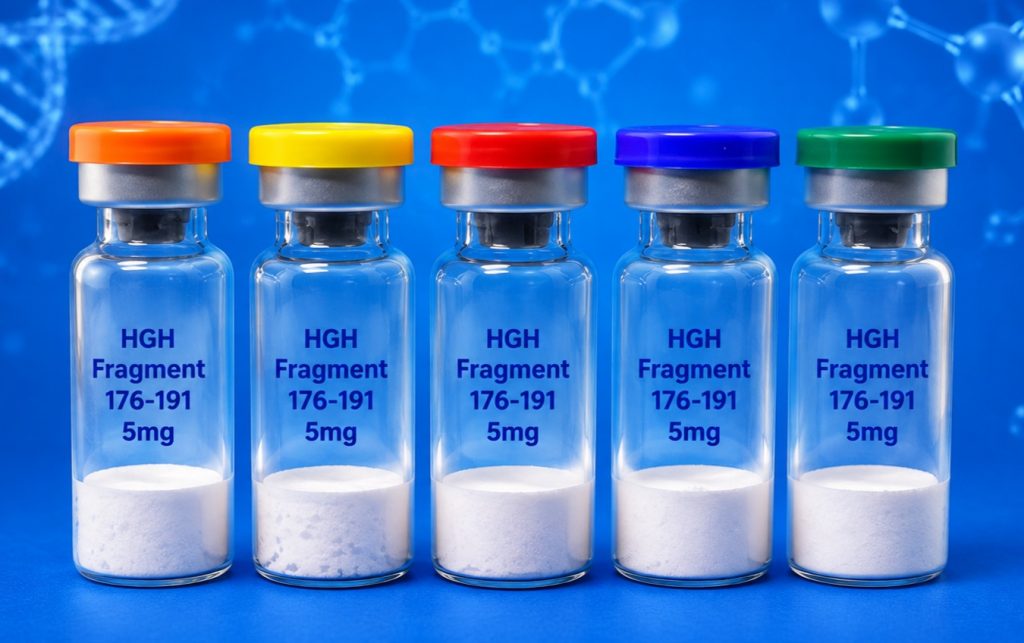
Three Similar Names. Three Different Research Materials.
Search for HGH Fragment 176-191 and you will quickly encounter three names:
HGH / Somatropin
HGH Fragment 176-191
AOD-9604
They are related.
They are not interchangeable.
For laboratories sourcing HGH Fragment research peptide, understanding that distinction is more important than repeating another list of online “benefits.”
What Is HGH Fragment 176-191?
Human growth hormone is a 191-amino-acid protein.
HGH Fragment 176-191 corresponds specifically to the final 16 amino acids at the C-terminal region of human growth hormone.
SUNONE currently identifies the research material as:
HGH Fragment 176-191
Somatotropin (176-191)
hGH (176-191)
Growth Hormone Fragment 176-191
with CAS 66004-57-7 and molecular weight approximately 1799.1 g/mol.
That makes it a defined peptide fragment—not full-length recombinant human growth hormone.
HGH Fragment 176-191 Is Not Somatropin
This distinction sounds obvious, but Google content frequently blurs it.
Full-length somatropin contains the complete 191-amino-acid human growth hormone sequence and has a substantial pharmaceutical and clinical literature.
HGH Fragment 176-191 contains only its C-terminal 16-residue region.
Therefore:
research involving full-length HGH should not automatically be presented as evidence for HGH Fragment 176-191.
Molecular relationship is not experimental equivalence.
And HGH Fragment 176-191 Is Not AOD-9604
This distinction is even easier to miss.
AOD-9604 was developed from the C-terminal region of human growth hormone and is closely related to HGH Fragment 176-191.
But AOD-9604 incorporates an additional N-terminal tyrosine and is therefore a distinct research molecule.
That means researchers should not automatically transfer:
AOD-9604 clinical results → HGH Fragment 176-191
or:
HGH Fragment 176-191 research → AOD-9604
without verifying which molecule was actually studied.
For literature reviews, procurement and analytical work, one residue can change the identity of the research material.
What Do HGH Fragment Reviews Actually Say?
Online sentiment is surprisingly divided.
Some users describe modest perceived body-composition effects, while acknowledging that the results are subtle.
Others report spending considerable time and money on HGH Fragment 176-191 while noticing essentially no effect.
Another long-term anecdotal report similarly described no meaningful result, while acknowledging that supplier quality could have been a confounding factor.
That last point is particularly relevant to research procurement.
If molecular identity and batch quality are unknown, a user experience cannot tell researchers much about the peptide itself.
Testimonials are not analytical data.
Why the Evidence Gap Is Actually the Important Story
Current discussions frequently describe HGH Fragment 176-191 as a peptide associated with lipid-metabolism research, but controlled human outcome data for this exact fragment remain limited compared with the evidence available for related molecules.
For scientific content, that means mechanism, related-molecule evidence and human clinical efficacy should be kept separate.
A stronger research article asks:
Was HGH Fragment 176-191 itself studied?
Was it AOD-9604?
Or was it full-length human growth hormone?
Those questions prevent a related molecule’s evidence from being incorrectly transferred to another product.
What Should an HGH Fragment 176-191 Buyer Verify?
For laboratories evaluating an HGH Fragment 176-191 supplier, the important questions include:
Sequence identity — Does the supplied material correspond to hGH residues 176–191?
Molecular identity — Does appropriate analytical testing support the intended peptide?
HPLC purity — Is the reported purity linked to the supplied batch?
Mass data — Is HPLC/MS documentation available according to the ordered specification?
Batch COA — Does the Certificate of Analysis correspond to the actual shipment?
Traceability — Can the material be connected to its production and QC records?
A familiar product name is useful.
A verified molecular identity is better.
SUNONE HGH Fragment 176-191 Research Peptide
SUNONE supplies HGH Fragment 176-191 for qualified laboratory, analytical and manufacturing research.
Current product information includes:
CAS: 66004-57-7
Molecular Formula: C78H123N23O22S2
Molecular Weight: 1799.1 g/mol
Purity / Grade: ≥98% HPLC
Form: Lyophilized Solid
Storage: 2–8°C, cold-chain
Documentation: batch-specific COA, HPLC/MS data and manufacturing specifications according to the ordered specification.
View SUNONE HGH Fragment 176-191 Specifications :
Looking for an HGH Fragment 176-191 Supplier with COA?
For peptide laboratories, biotechnology companies and research distributors, the sourcing question should not simply be:
“Do you supply HGH Fragment?”
A stronger question is:
“Can you confirm that this batch is HGH Fragment 176-191—and not another related GH-derived peptide?”
If your organization is evaluating HGH Fragment 176-191, Somatotropin 176-191, GH Fragment 176-191 or other growth-hormone-derived research peptides, SUNONE can provide current batch specifications, analytical documentation, packaging information and B2B quotation support.
Conclusion
HGH Fragment 176-191 illustrates a simple problem in peptide research:
related molecules are frequently treated as interchangeable evidence.
But HGH Fragment 176-191 is not full-length HGH.
And it is not AOD-9604.
For professional research procurement:
verify the exact fragment, verify the molecular identity, verify the HPLC/MS data and verify the batch-specific COA.
The familiar HGH name may attract the search.
Molecular clarity should generate the inquiry.
This content is provided for scientific and educational purposes only. SUNONE research peptide is for qualified labrtorynt, diagnois, druc tor mmatct or veteimant, use.research only, Not for human consumption, clinical treame. Purchasers are responsible for complying with applicable laws and regulations in their jurisdiction.
Leave a Reply