
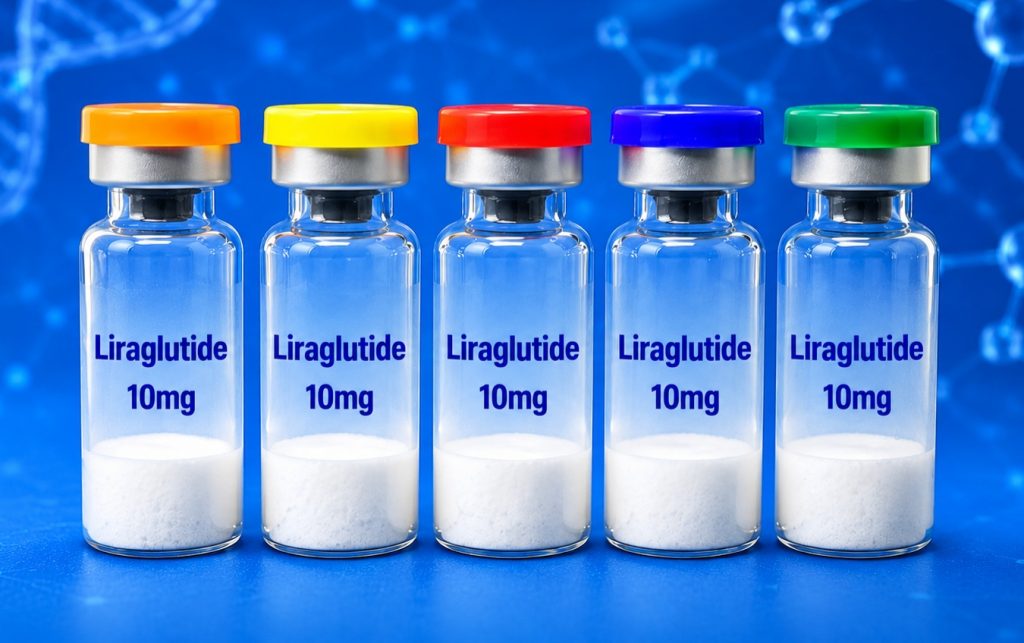
Liraglutide Is Familiar. That Can Be Misleading.
In today’s GLP-1 market, Liraglutide may look almost old-fashioned beside semaglutide and newer multi-receptor peptides.
But familiarity creates a sourcing problem:
Seeing the word “Liraglutide” does not tell a laboratory what product category it is buying.
The same molecular name can appear in pharmaceutical products, approved generics, analytical standards and research-grade peptide materials.
Those products should not automatically be treated as interchangeable.
What Is Liraglutide?
Liraglutide—also known as NN2211—is an acylated GLP-1 analogue with CAS 204656-20-2 and molecular weight approximately 3751.2 Da.
Research suppliers commonly describe it as a 31-amino-acid GLP-1 analogue containing a lipid modification that contributes to its extended pharmacological profile. Current laboratory listings emphasize GLP-1 receptor signaling, analytical characterization and metabolic-pathway research.
This supports search terms such as:
Liraglutide peptide, NN2211, GLP-1 analog, GLP-1 receptor agonist and Liraglutide research peptide.
Liraglutide Is Also an Approved Drug Molecule
Liraglutide has a well-established pharmaceutical history.
FDA-approved products include Victoza, associated with type 2 diabetes indications, and Saxenda, associated with chronic weight-management indications. FDA has also approved generic liraglutide products referencing these finished medicines.
That history is scientifically useful.
But it creates an important B2B distinction:
Research-grade Liraglutide raw material is not automatically Victoza, Saxenda or an FDA-approved generic drug.
An approved finished drug has defined formulation, manufacturing controls, device configuration, regulatory specifications and release requirements.
A research peptide should therefore be evaluated according to its own specification and batch documentation.
Why “98% HPLC” Is Only One Part of the Story
For peptide procurement, purity and content are not the same measurement.
A recent independent liraglutide assay illustrates this clearly: one tested lot showed 99.59% chromatographic purity, while total peptide content was reported as 89.00% w/w.
That does not mean one measurement is wrong.
It means they answer different questions.
Professional buyers should distinguish:
HPLC purity — How much of the chromatographic signal belongs to the main component?
Molecular identity — Does mass or equivalent analysis support Liraglutide?
Peptide content — How much target peptide is actually present by mass?
Water/counterion content — What else contributes to total material mass?
Batch COA — Does the documentation correspond to the actual shipment?
This is particularly important when evaluating Liraglutide suppliers with COA.
What Do Positive and Negative Liraglutide Reviews Say?
Real-world discussions are mixed.
Some users describe improved appetite control, more stable subjective blood-sugar experience or satisfactory progress. Others report nausea, bloating, poor response or no meaningful weight change.
Clinical research also shows both sides of the story: randomized research found greater weight reduction with Liraglutide than placebo in the studied population, while nausea and vomiting occurred more frequently.
These observations describe pharmaceutical or uncontrolled user experiences.
They do not establish efficacy, safety or pharmaceutical equivalence for an independently supplied research material.
For B2B procurement, testimonials are less useful than analytical documentation.
SUNONE Liraglutide Research Peptide
SUNONE supplies Liraglutide / NN2211 for qualified laboratory research, analytical development and biopharmaceutical manufacturing applications.
Current product information includes:
CAS: 204656-20-2
Molecular Formula: C172H265N43O51
Molecular Weight: 3751.2 g/mol
Purity / Grade: ≥98%, HPLC
Form: Lyophilized
Storage: 2–8°C
Documentation: COA, SDS, Specification Sheet and HPLC/MS information where applicable.
View SUNONE Liraglutide Specifications :
Looking for a Liraglutide Supplier with COA?
For peptide laboratories, biotechnology companies and research distributors, the best question is not simply:
“Is this Liraglutide?”
A stronger procurement question is:
“Can the supplier document its molecular identity, purity, content and batch traceability?”
If your organization is evaluating Liraglutide peptide, NN2211, GLP-1 research materials or related metabolic peptides, SUNONE can provide current specifications, packaging, MOQ, batch documentation and B2B quotation information.
Conclusion
Liraglutide may be one of the older GLP-1 molecules.
That does not make sourcing simple.
Same molecule name does not mean same finished product.
High HPLC purity does not automatically mean high peptide content.
And research-grade material should not be presented as an approved pharmaceutical.
For professional procurement:
verify identity, verify purity, verify content and verify the batch-specific COA.
The familiar GLP-1 name may generate the search.
Analytical transparency should generate the inquiry.
This content is provided for scientific and educational purposes only. SUNONE research peptide is for qualified labrtorynt, diagnois, druc tor mmatct or veteimant, use.research only, Not for human consumption, clinical treame. Purchasers are responsible for complying with applicable laws and regulations in their jurisdiction.
Leave a Reply