
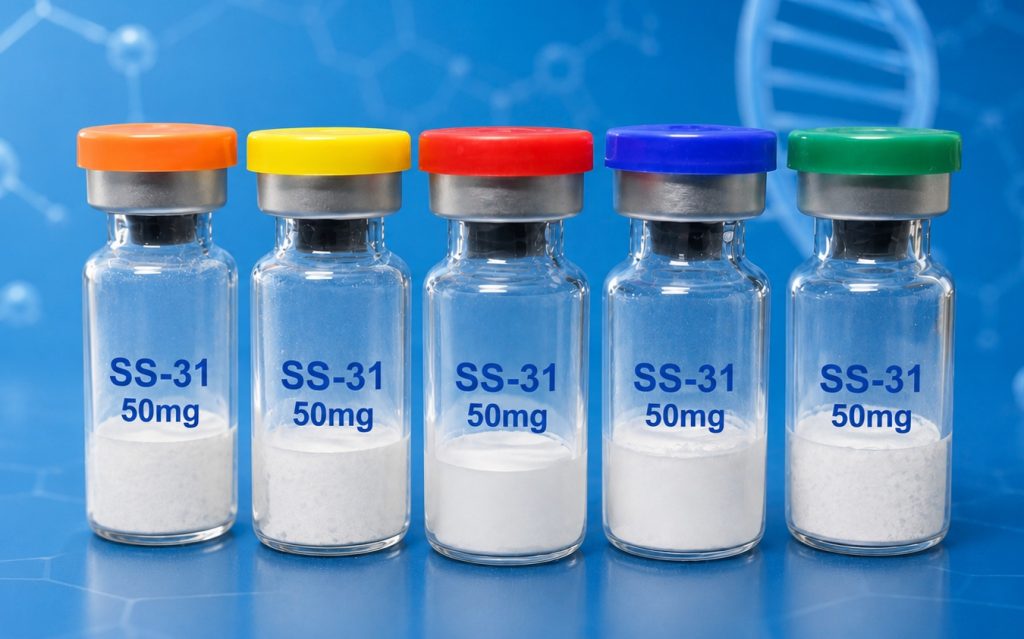
SS-31 Has Crossed a Major Scientific Milestone
For years, SS-31 peptide was mainly discussed as an experimental mitochondria-targeted compound.
That changed in September 2025.
The U.S. FDA granted accelerated approval to Forzinity (elamipretide) for improving muscle strength in adults and children with Barth syndrome weighing at least 30 kg.
That is a major milestone for mitochondrial peptide research.
But it also creates a new sourcing misconception:
An FDA-approved drug containing elamipretide does not make every SS-31 research product an FDA-approved pharmaceutical.
What Is SS-31 / Elamipretide?
SS-31—also known as Elamipretide, MTP-131, Bendavia or Szeto-Schiller Peptide 31—is a mitochondria-targeted tetrapeptide.
Research has focused heavily on its interaction with cardiolipin, a phospholipid concentrated in the inner mitochondrial membrane.
Published reviews describe SS-31 research in relation to:
- mitochondrial membrane structure;
- cardiolipin biology;
- electron-transport-chain organization;
- mitochondrial bioenergetics;
- oxidative-stress signaling;
- skeletal-muscle and cardiovascular models.
Current research suggests its mechanism is more complex than simply acting as a conventional antioxidant.
That makes SS-31 mitochondrial research scientifically interesting well beyond the usual “energy peptide” marketing language.
FDA Approval Does Not Mean Every Elamipretide Product Is Equivalent
This distinction is especially important in 2026.
FDA’s approved product is Forzinity, developed for a specific rare-disease indication under accelerated approval.
The evidence used for approval came from a very small Barth syndrome population. FDA’s trial summary notes that the randomized phase did not show superiority on the original six-minute-walk and fatigue primary endpoints; the accelerated approval instead relied on improvement in knee extensor muscle strength observed over longer-term follow-up. FDA is requiring a confirmatory trial to verify clinical benefit.
This is a much more precise scientific story than:
“SS-31 is now clinically proven for mitochondrial health.”
It is approved for a defined indication, population and pharmaceutical product.

Chemical Form Is Not a Small Detail
The name Elamipretide can hide an important analytical distinction.
FDA’s substance database identifies the approved Forzinity ingredient as elamipretide hydrochloride / elamipretide trihydrochloride.
SUNONE’s current SS-31 research listing identifies:
CAS 736992-21-5
Formula C32H49N9O5
Molecular weight 611.78 g/mol
≥99% HPLC
Lyophilized powder.
That means professional researchers should not rely on the name alone.
They should ask:
Which chemical form is being supplied?
That question matters for molecular weight interpretation, analytical testing and reproducibility.
Positive and Negative SS-31 Reviews Are Highly Mixed
Community interest in SS-31 has increased substantially.
Some users report perceived improvements in:
- energy;
- stamina;
- daily activity;
- recovery.
Other users say they noticed little or no effect.
Negative anecdotes include fatigue, gastrointestinal symptoms and other uncomfortable reactions.
These reports are not controlled clinical evidence.
They also cannot establish whether different online products actually contained equivalent SS-31 material.
For professional laboratories, that makes batch verification more important than testimonial volume.
Why a “99% Purity” Number Is Not Enough
Current SS-31 supplier search results increasingly emphasize batch-specific documentation.
That is a useful trend.
HPLC purity tells researchers something important—but not everything.
A strong SS-31 documentation package should help answer:
Identity
Does the supplied material correspond to the intended SS-31 structure?
Chemical form
Is the relevant salt or counter-ion state clearly defined?
HPLC purity
Is chromatographic purity tied to the exact production lot?
Analytical identity
Are appropriate identity data available according to specification?
Batch-specific COA
Does the certificate correspond to the material being shipped?
Traceability
Can the material be connected to its batch and quality records?
Current third-party testing databases also demonstrate that purity percentage, water content, counter-ion content and peptide content can represent different analytical questions. A single purity number should therefore not be interpreted as the complete composition of a research material.
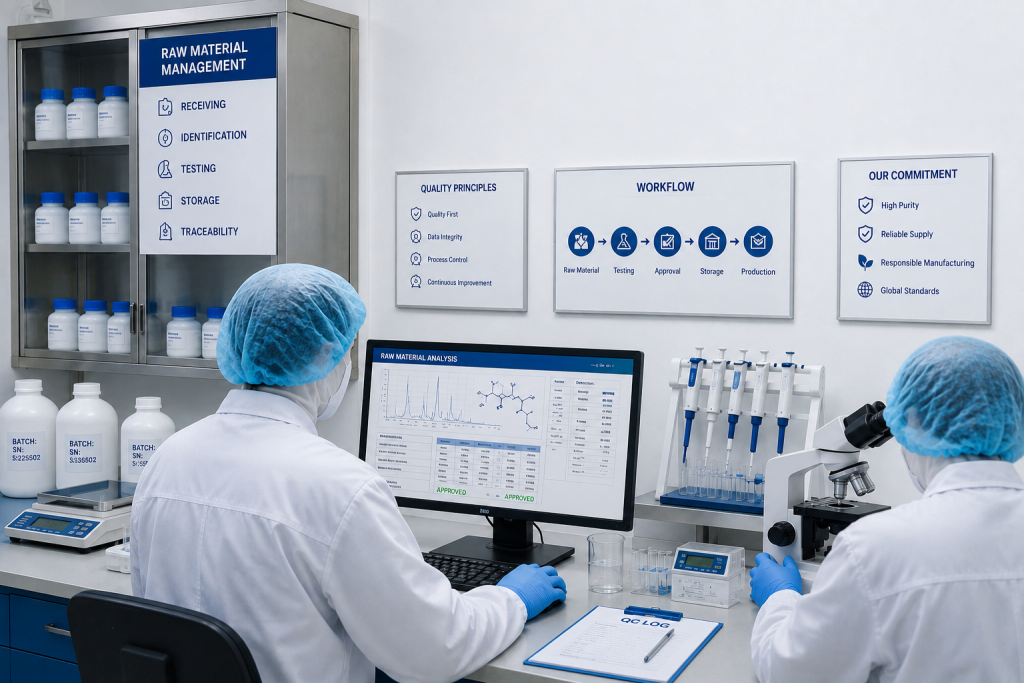
SUNONE SS-31 Research Peptide
SUNONE supplies SS-31 / Elamipretide research peptide for qualified laboratory and manufacturing applications.
Current SUNONE product information includes:
Product: SS-31 / Elamipretide
Synonyms: Bendavia, MTP-131, Szeto-Schiller Peptide 31
CAS: 736992-21-5
Molecular Formula: C32H49N9O5
Molecular Weight: 611.78 g/mol
Purity: ≥99% HPLC
Form: Lyophilized powder
B2B sizes: 5 mg, 10 mg and 50 mg
Documentation: COA, SDS and Specification Sheet.
View SUNONE SS-31 Specifications & Request a Quote:
Looking for an SS-31 Supplier with COA?
For mitochondrial-research laboratories, biotechnology companies and peptide distributors, the sourcing question should no longer simply be:
“Do you supply Elamipretide?”
A better question is:
“Which Elamipretide form does this batch contain, and can the supplier document its identity and purity?”
If your organization is evaluating SS-31 peptide, Elamipretide research material, MTP-131, cardiolipin-binding peptides, or other mitochondria-targeted research peptides, SUNONE can provide current specifications, batch documentation, MOQ, packaging information and B2B quotation support.
Conclusion
SS-31 now occupies an unusual position in peptide research.
It has:
a well-developed mitochondrial mechanism, extensive preclinical literature, human clinical research—and an FDA-approved pharmaceutical product.
But that makes analytical precision more important, not less.
Forzinity is a regulated finished medicine. Research-grade SS-31 is research material. The two should never be assumed equivalent simply because both use the name Elamipretide.
For professional procurement:
verify the chemical form, verify the identity, verify the HPLC data and verify the batch-specific COA.
The approval story may attract the search.
The analytical documentation should earn the inquiry.
This content is provided for scientific and educational purposes only. SUNONE research peptide is for qualified labrtorynt, diagnois, druc tor mmatct or veteimant, use.research only, Not for human consumption, clinical treame. Purchasers are responsible for complying with applicable laws and regulations in their jurisdiction.
Leave a Reply