
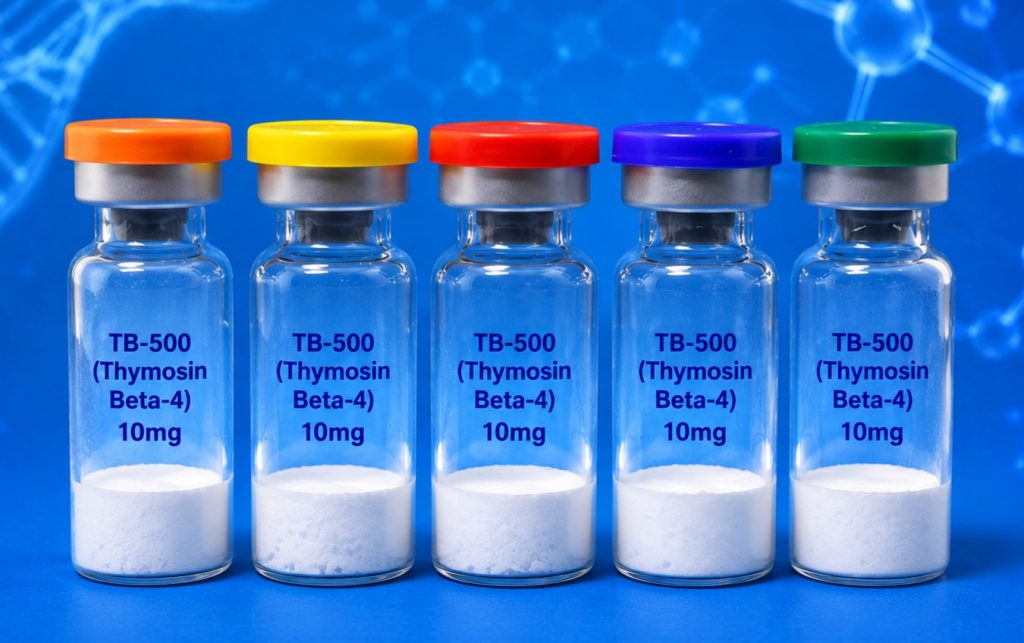
TB-500 and Thymosin Beta-4 Are Often Treated as the Same Thing. They Aren’t.
Search for TB-500 peptide and you will quickly encounter claims about wound healing, angiogenesis, tissue repair and cell migration.
There is one major problem:
A large portion of that research was performed with full-length thymosin β4—not TB-500.
TB-500 is a much smaller molecule.
Analytical research identified TB-500 as the N-terminally acetylated seven-amino-acid sequence:
Ac-LKKTETQ
corresponding to residues 17–23 of human thymosin β4.
That distinction should be the starting point of any serious TB-500 research peptide discussion.
Seven Amino Acids vs 43 Amino Acids
Full-length thymosin β4 is a 43-amino-acid actin-binding peptide studied extensively in cell migration, tissue repair and wound biology.
Classic research reported effects of full-length Tβ4 in dermal wound models, angiogenesis and connective-tissue repair.
TB-500, however, represents only the 17–23 region of that parent molecule.
SUNONE’s current TB-500 specification identifies the material as:
Ac-Leu-Lys-Lys-Thr-Glu-Thr-Gln
Ac-LKKTETQ
Thymosin β4 Fragment 17–23.
Researchers therefore should not automatically transfer every full-length Tβ4 result to the TB-500 fragment.
Does the TB-500 Fragment Have Research of Its Own?
Yes—but the evidence needs to be described accurately.
A preclinical study evaluated thymosin β4 together with a synthetic peptide containing its actin-binding domain in diabetic and aged mouse wound models. This provides experimental support for investigating shorter Tβ4-derived sequences.
However, that is not the same as having a broad human clinical evidence base for commercial TB-500 / Ac-LKKTETQ.
For SEO content, this distinction matters.
A scientifically accurate article should say:
“TB-500 is derived from an experimentally important region of thymosin β4.”
It should not automatically say:
“Every benefit demonstrated for thymosin β4 has been proven for TB-500.”
Why Positive TB-500 Reviews Need Context
Online interest in TB-500 is heavily driven by anecdotal recovery stories.
Some users report perceived improvements in pain, mobility or recovery. Recent community posts describing BPC-157 + TB-500 combinations include positive recovery experiences.
But these stories have several limitations:
the peptides are often used together, product identity is rarely independently confirmed, training and rehabilitation are simultaneous, and the observations are uncontrolled.
That makes it impossible to assign the outcome specifically to TB-500.
Combination anecdotes are not TB-500 monotherapy evidence.
Negative TB-500 Experiences Exist Too
Positive reviews are not the whole picture.
A 2026 user report described emotional numbness, brain fog and a general feeling of being unwell after a product identified as TB-500.
Other combination discussions mention headaches, dizziness, fatigue or other uncomfortable effects.
These reports do not establish causality.
They also underline an important research-procurement issue:
Was the material actually TB-500, and was its identity analytically verified?
For TB-500 Buyers, Sequence Identity Matters More Than Marketing Language
A product called “Thymosin Beta-4” may not necessarily be full-length Tβ4.
A product called “TB-500” should therefore be evaluated by its actual molecular specification.
Professional laboratories should verify:
Sequence identity — Does the material correspond to Ac-LKKTETQ?
Fragment definition — Is it clearly identified as thymosin β4 residues 17–23?
Molecular identity — Are appropriate analytical data available?
HPLC purity — Is the purity result linked to the actual batch?
Batch COA — Does the certificate correspond to the material being supplied?
Traceability — Can the lot be linked to its analytical documentation?
For research reproducibility:
“TB-500” is a name. Ac-LKKTETQ is an identity.
SUNONE TB-500 Research Peptide
SUNONE supplies TB-500 / Thymosin β4 Fragment 17–23 for qualified laboratory and manufacturing research.
Current SUNONE specifications include:
Product: TB-500
Sequence: Ac-LKKTETQ
CAS: 885340-08-9
Molecular Formula: C38H68N10O14
Molecular Weight: 889.0 g/mol
Purity / Grade: ≥99.1%, HPLC
Form: Lyophilized Peptide
B2B Sizes: 5 mg and 10 mg
Documentation: SDS, Certificate of Analysis and Specification Sheet.
View SUNONE TB-500 Specifications :
Looking for a TB-500 Supplier with COA?
For peptide laboratories, biotechnology companies and research distributors, the most important question is not simply:
“Do you supply TB-500?”
A better question is:
“Can you confirm that this batch is Ac-LKKTETQ—and document its identity and purity?”
If your organization is sourcing TB-500 peptide, Thymosin Beta-4 Fragment 17-23, Ac-LKKTETQ or related actin-associated research peptides, SUNONE can provide current specifications, batch documentation, packaging, MOQ and B2B quotation information.
Conclusion
The biggest misconception surrounding TB-500 is surprisingly simple:
TB-500 is related to thymosin β4—but it is not the full-length thymosin β4 molecule.
That means research results must be attributed to the molecule that was actually studied.
For professional sourcing, the same principle applies:
verify the sequence, verify the identity, verify the HPLC purity and verify the batch-specific COA.
The product name may generate traffic.
Molecular clarity should generate the inquiry.
This content is provided for scientific and educational purposes only. SUNONE research peptide is for qualified labrtorynt, diagnois, druc tor mmatct or veteimant, use.research only, Not for human consumption, clinical treame. Purchasers are responsible for complying with applicable laws and regulations in their jurisdiction.
Leave a Reply