

VIP Is Not a New Peptide. That Is What Makes It Interesting.
Many peptides become popular before researchers know much about them.
Vasoactive Intestinal Peptide (VIP) has the opposite story.
First identified more than five decades ago, VIP is a 28-amino-acid neuropeptide studied across the nervous system, lungs, gastrointestinal biology, immune signaling and vascular biology.
Modern research connects VIP with VPAC receptors, neuropeptide signaling, vasodilation, immune modulation and pulmonary biology.
Yet after decades of research, VIP still presents a fundamental scientific challenge:
an interesting biological peptide is not necessarily an easy research molecule.
What Is Vasoactive Intestinal Peptide?
VIP—also known as Vasoactive Intestinal Polypeptide—is a naturally occurring 28-amino-acid peptide.
SUNONE identifies the human VIP research sequence as:
HSDAVFTDNYTRLRKQMAVKKYLNSILN
with CAS 37221-79-7 and molecular weight approximately 3326.8 g/mol.
VIP research commonly involves:
- VPAC receptor signaling;
- neuropeptide biology;
- cellular communication;
- pulmonary signaling;
- immune-response pathways;
- peptide–receptor interactions;
- structure–activity relationships.
That broad biology explains why VIP peptide research continues to attract attention.
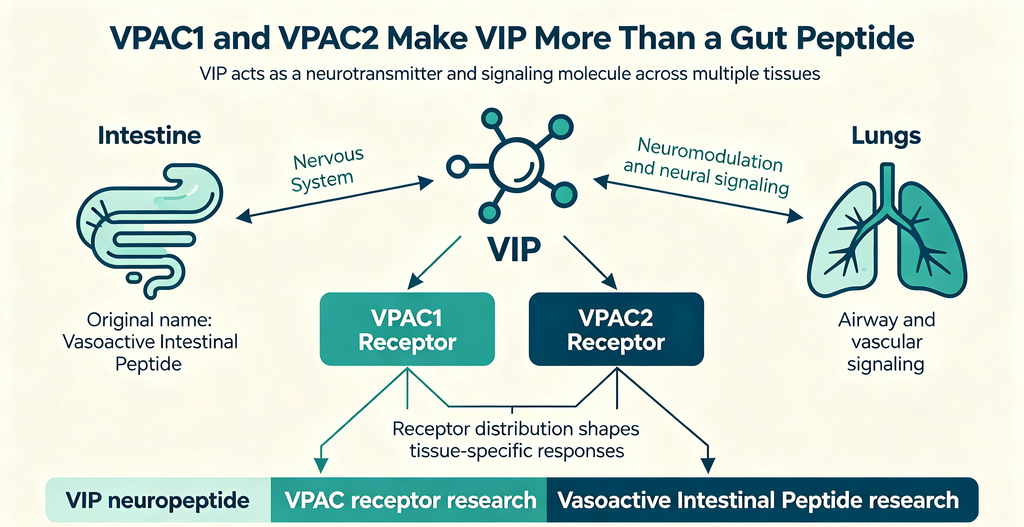
VPAC1 and VPAC2 Make VIP More Than a “Gut Peptide”
The name “Vasoactive Intestinal Peptide” can be misleading.
VIP is not restricted to the intestine.
It functions as a neurotransmitter and signaling molecule in multiple tissues, including the lungs and nervous system. Research has investigated its interactions with the VPAC1 and VPAC2 receptors and its effects on vascular, airway and immune signaling.
This makes terms such as VIP neuropeptide, VPAC receptor research and Vasoactive Intestinal Peptide research more scientifically useful than treating VIP simply as a digestive peptide.
The Most Interesting VIP Problem May Be Stability
VIP has biologically interesting signaling properties—but native VIP also has practical limitations.
Research reviews repeatedly identify its short plasma half-life and delivery challenges as barriers to pharmaceutical development. This has driven substantial interest in stabilized VIP analogues and alternative delivery systems.
For laboratory procurement, this creates a different question from the usual:
“How pure is the peptide?”
Purity matters, but so do:
identity, sequence integrity, handling conditions, storage and batch-specific analytical documentation.
A highly pure peptide that has not been appropriately characterized or handled can still create unreliable experimental data.
Positive and Negative VIP Reviews Reveal a Large Evidence Gap
Current community discussions are surprisingly sparse considering VIP’s long scientific history.
Some users describe perceived changes involving brain fog, inflammation, circulation or gastrointestinal function.
Others report little noticeable effect or describe strong flushing and other uncomfortable subjective experiences.
These reports are anecdotal.
They cannot determine clinical efficacy, safety or causality—and they certainly should not be used to create research protocols.
In fact, the gap between extensive biological literature and limited controlled human evidence for many proposed applications is one of the most important facts about VIP.
VIP Is Also Called Aviptadil—but Names Require Context
Search results frequently connect VIP with Aviptadil.
This terminology can create another procurement problem.
A product name alone does not establish pharmaceutical equivalence, formulation equivalence or suitability for clinical use.
Professional researchers sourcing Vasoactive Intestinal Peptide should verify the actual molecular material rather than relying on synonyms.
Useful questions include:
Is the sequence correct?
Is molecular identity documented?
Is HPLC purity linked to this batch?
Does the COA correspond to the supplied lot?
Are storage conditions clearly documented?
For peptide research, the name starts the identification process.
The analytical documentation completes it.

SUNONE VIP Research Peptide
SUNONE supplies VIP / Vasoactive Intestinal Peptide for qualified laboratory, analytical and manufacturing research.
Current product information includes:
Product: Vasoactive Intestinal Peptide (VIP)
Synonyms: Vasoactive Intestinal Polypeptide, VIP, Aviptadil
CAS: 37221-79-7
Molecular Formula: C147H237N43O43S
Molecular Weight: 3326.8 g/mol
Sequence Length: 28 amino acids
Grade: ≥99% HPLC
Form: Lyophilized
B2B Sizes: 5 mg and 10 mg
Documentation: COA, SDS and Specification Sheet.
View SUNONE VIP Specifications :
Looking for a VIP Peptide Supplier with COA?
For biotechnology companies, peptide laboratories and research distributors, the most useful sourcing question is not:
“What can VIP treat?”
For research procurement, the better question is:
“Can the supplier verify the identity, purity and batch characteristics of the VIP peptide being supplied?”
If your organization is sourcing VIP peptide, Vasoactive Intestinal Peptide, Vasoactive Intestinal Polypeptide, Aviptadil research material, or peptides for VPAC receptor research, SUNONE can provide current specifications, batch documentation, MOQ, packaging and B2B quotation information.
Request VIP COA, Specifications & B2B Quote from SUNONE:
Conclusion
VIP has been studied for decades because its biology reaches far beyond its name.
Its role in neuropeptide signaling, VPAC receptor biology, pulmonary research and immune signaling continues to make it scientifically relevant.
But its research history also teaches an important lesson:
biological potential does not eliminate stability, evidence or analytical challenges.
For professional research procurement, the strongest approach remains simple:
verify the sequence, verify the identity, verify the purity—and verify the batch.
This content is provided for scientific and educational purposes only. SUNONE research peptide is for qualified labrtorynt, diagnois, druc tor mmatct or veteimant, use.research only, Not for human consumption, clinical treame. Purchasers are responsible for complying with applicable laws and regulations in their jurisdiction.
Leave a Reply