
MOTS-c Has a Powerful Story. The Evidence Needs Precise Labels.
Search MOTS-c peptide today and phrases such as:
“mitochondrial peptide”
“exercise mimetic”
“metabolic peptide”
“energy peptide”
appear repeatedly.
The underlying biology is genuinely interesting.
But for scientific procurement, one distinction is essential:
finding MOTS-c naturally in human biology is not the same as proving what externally supplied MOTS-c does in humans.
That distinction is where better research—and better sourcing—starts.
What Is MOTS-c?
MOTS-c stands for Mitochondrial Open Reading Frame of the 12S rRNA-c.
It is a 16-amino-acid mitochondrial-derived peptide with the sequence:
MRWQEMGYIFYPRKLR
SUNONE lists MOTS-c under CAS 1627580-64-6, molecular formula C101H152N28O22S2 and molecular weight approximately 2174.6 g/mol.
Relevant search terms therefore include MOTS-c peptide, mitochondrial-derived peptide, mitochondrial signaling peptide, cellular energy metabolism peptide and MOTS-c research peptide.
Human MOTS-c Research Does Not Automatically Prove Exogenous MOTS-c Effects
MOTS-c has been measured naturally in human circulation and skeletal muscle.
In a controlled human exercise study, researchers evaluated changes in endogenous MOTS-c following endurance and resistance exercise.
Other human research has compared circulating MOTS-c levels in athletes and non-athletes.
These studies are valuable.
But they answer questions about endogenous MOTS-c biology.
They do not automatically demonstrate that externally supplied MOTS-c produces improved endurance, fat loss, anti-aging effects or metabolic outcomes in humans.
For responsible scientific content:
biological association should not be rewritten as therapeutic efficacy.

Why “Exercise Mimetic” Can Be an Over-Simplified Keyword
Preclinical research has generated interest in MOTS-c because of its connections with cellular energy regulation, metabolic signaling and stress-response pathways.
That is why the phrase “exercise mimetic peptide” appears so frequently online.
But most mechanistic and efficacy claims still originate from cell and animal research rather than large completed human intervention trials.
A 2026 evidence review of the literature similarly notes that most evidence remains preclinical and that completed human efficacy data for administered MOTS-c remain limited.
For B2B research buyers, this actually creates a stronger positioning opportunity:
sell analytical clarity—not exaggerated outcome claims.
FDA Has Also Distinguished MOTS-c Free Base and MOTS-c Acetate
In July 2026, FDA reviewed both MOTS-c free base and MOTS-c acetate in the context of the 503A Bulks List.
FDA proposed that neither form be included on that list. This was a compounding-policy evaluation, not an approval of MOTS-c as a drug.
FDA’s technical material also distinguishes MOTS-c acetate as a specific salt form and notes that aggregation and degradation can depend on formulation, manufacturing processes and environmental conditions.
This has an important procurement implication:
“MOTS-c” alone may not describe every relevant chemical characteristic of the supplied material.
Professional buyers should verify the form stated on the specification and COA.
Positive and Negative MOTS-c Reviews Are Extremely Mixed
Current community experiences are inconsistent.
Some 2026 users report more stable physical or mental energy, particularly during exercise, without describing a stimulant-like surge.
Other users say MOTS-c produced little or no noticeable effect.
Negative discussions include fatigue, sedative-like sensations, itching and injection-site reactions. Other anecdotal posts describe allergy-like reactions, though product identity, purity and causality generally cannot be verified from forum reports.
These online experiences should therefore remain separate from controlled scientific evidence.
Reviews describe perception.
Analytical documentation describes the batch.
Why MOTS-c Buyers Are Looking Beyond a Purity Percentage
Current 2026 research-supplier certificates increasingly separate:
HPLC purity
mass-spectrometry identity
net peptide content
lot number
batch traceability
Recent MOTS-c certificates, for example, report molecular mass alongside HPLC purity rather than treating purity alone as proof of identity.
That distinction matters.
HPLC asks how pure the principal chromatographic component appears.
Mass confirmation asks whether that component is consistent with the intended molecule.
Net content asks how much peptide material is actually present.
Professional procurement should treat these as different analytical questions.

SUNONE MOTS-c Research Peptide
Sunone (Hong Kong) Biopharmaceutical International Technology Co., Limited supplies MOTS-c for qualified laboratory, analytical and manufacturing research.
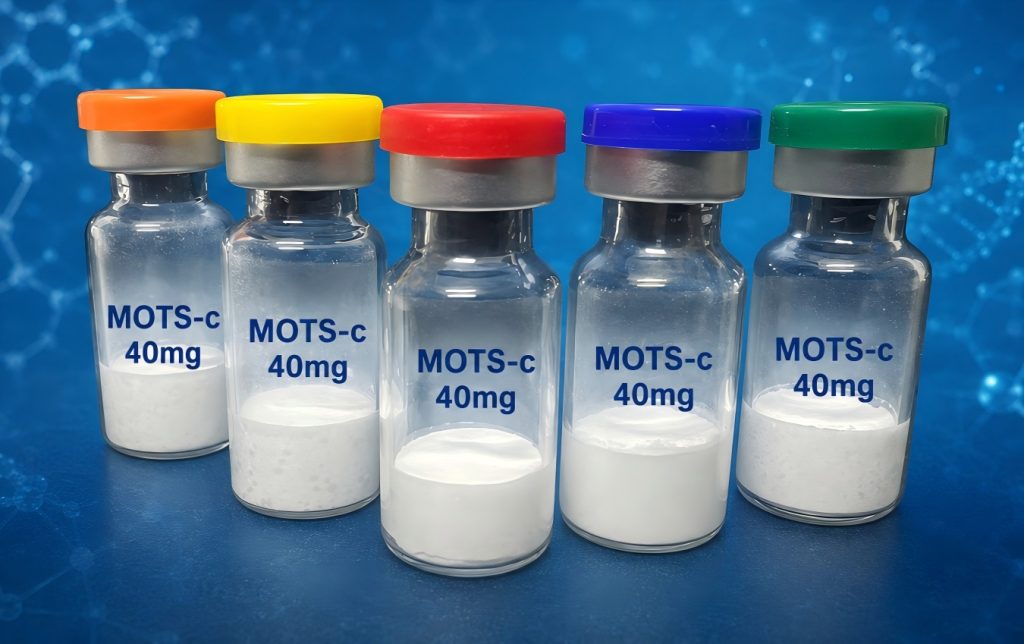
Current SUNONE information lists research-grade lyophilized MOTS-c in 10 mg, 20 mg and 40 mg B2B configurations. Product identity, sequence, purity, salt form and analytical characteristics should be confirmed against the applicable batch-specific COA and SDS.
View SUNONE MOTS-c Specifications :
Looking for a MOTS-c Supplier with COA?
For biotechnology companies, peptide laboratories and research distributors, the strongest sourcing question is not:
“Is MOTS-c an exercise mimetic?”
It is:
“Can the supplier document exactly which MOTS-c research material this batch contains?”
If your organization is sourcing MOTS-c peptide, mitochondrial-derived peptide research material or related metabolic research peptides, SUNONE can provide current specifications, batch documentation, packaging, MOQ and B2B quotation information.
Conclusion
MOTS-c is scientifically interesting because it connects mitochondrial genetics with cellular signaling.
But that same story can easily become over-simplified online.
Endogenous human MOTS-c data are not the same as exogenous peptide efficacy data.
Preclinical metabolic findings are not proof of human performance or weight-loss benefits.
And “MOTS-c” alone does not replace confirmation of chemical form and batch identity.
For professional research sourcing:
verify identity, verify chemical form, verify HPLC and mass data, and verify the batch-specific COA.
The mitochondrial story may generate the search.
Analytical transparency should generate the inquiry.
This content is provided for scientific and educational purposes only. SUNONE research peptide is for qualified labrtorynt, diagnois, druc tor mmatct or veteimant, use.research only, Not for human consumption, clinical treame. Purchasers are responsible for complying with applicable laws and regulations in their jurisdiction.
Leave a Reply