
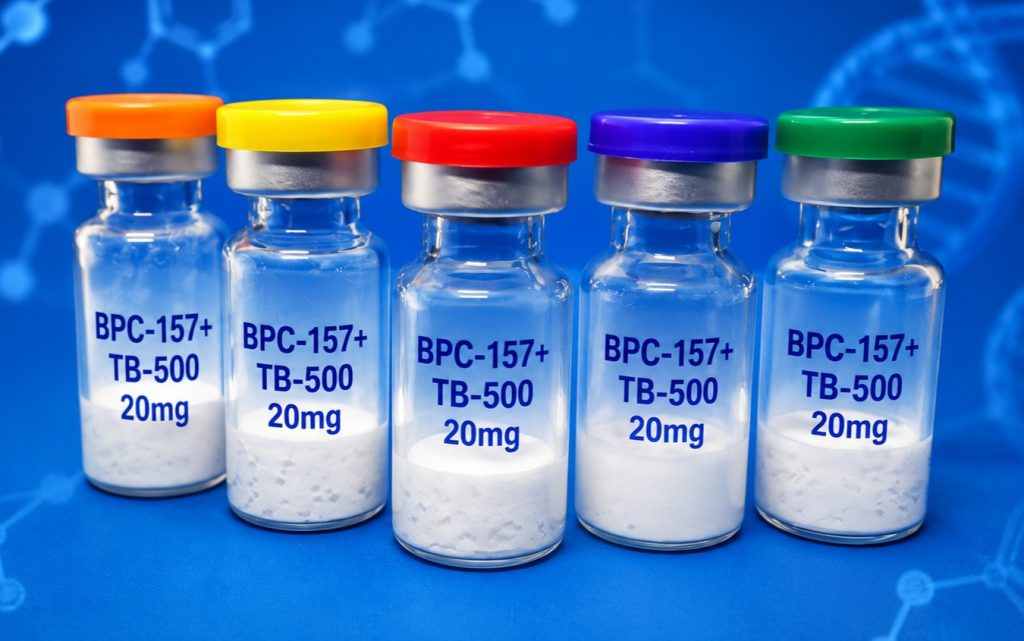
A BPC-157 + TB-500 vial may look simpler than buying two peptides separately. Analytically, however, a blend creates a harder question: can you prove that both peptides are present in the correct ratio?
For professional laboratories and B2B buyers, a product label is only the beginning.
What Is a BPC-157 + TB-500 Research Blend?
A BPC-157 + TB-500 peptide blend combines two chemically distinct research peptides in one lyophilized formulation.
Sunone currently supplies two configurations:
- 10 mg total: BPC-157 5 mg + TB-500 5 mg
- 20 mg total: BPC-157 10 mg + TB-500 10 mg
Both use a 1:1 component ratio.
Because this is a multi-component formulation, the finished blend does not have one scientifically meaningful CAS number, molecular formula or molecular weight.
Each component must be characterized separately.
Why “99% Purity” Does Not Prove a 1:1 Blend
This is the quality question many product pages overlook.
A headline such as ≥99% HPLC purity does not, by itself, answer:
- Is BPC-157 correctly identified?
- Is the TB-500-related component correctly identified?
- Are both components present?
- Is the ratio really 5 mg : 5 mg or 10 mg : 10 mg?
- Which peptide-related impurities are present?
- Is the composition consistent from lot to lot?
For a peptide blend, identity, purity and quantity are different analytical questions.
BPC-157 and TB-500 Are Not Equally Characterized
BPC-157 has an extensive preclinical research literature, but human data remain limited.
TB-500 terminology also requires care because the name is sometimes used inconsistently across the research-material market.
Professional documentation should therefore state the exact molecular identity or sequence rather than relying only on the term “TB-500.”
This matters because research involving full-length Thymosin β4 cannot automatically be treated as evidence for a shorter TB-500-related fragment.
What Do BPC-157 + TB-500 Reviews Say?
Online reviews are highly mixed.
Some users describe perceived changes involving:
- recovery;
- mobility;
- discomfort;
- training tolerance.
Others report:
- no noticeable result;
- nausea;
- fatigue or drowsiness;
- anxiety;
- gastrointestinal discomfort;
- headache or pressure sensations.
These reports are anecdotal.
Product source, identity, purity, concurrent substances and individual health conditions are usually unknown.
Testimonials cannot establish the safety, efficacy or quality of a research peptide batch.
What Should B2B Buyers Verify?
1. Confirm Both Molecular Identities
A professional BPC-157 + TB-500 COA should clearly define both components.
“Blend” alone is not an analytical identity.
2. Verify the Ratio
For a 1:1 research blend, quantitative documentation should support the expected amount of each component.
Total vial mass alone does not prove component ratio.
3. Review HPLC and Identity Data Separately
HPLC can provide chromatographic purity information.
Where appropriate, MS or LC-MS can provide additional evidence for expected molecular identity.
For multi-peptide formulations:
purity is not identity, and identity is not quantity.
4. Verify What “TB-500” Means
Professional buyers should confirm the exact sequence, molecular form and applicable specification of the TB-500-related component.
This reduces ambiguity between TB-500 terminology and full-length Thymosin β4 research.
5. Request Batch-Specific Documentation
Depending on the research application, buyers may consider reviewing:
- Certificate of Analysis;
- BPC-157 identity;
- TB-500 component identity;
- component ratio;
- HPLC data;
- MS / LC-MS data;
- peptide-related impurity information;
- lot number;
- SDS;
- storage conditions;
- batch traceability.
BPC-157 + TB-500 Research Blend from Sunone
Sunone (Hong Kong) Biopharmaceutical International Technology Co., Limited supplies BPC-157 + TB-500 Research Blend for qualified laboratory research and biotechnology manufacturing applications.
Current specifications include:
Product: BPC-157 + TB-500 Research Blend
Grade: Research Grade
Form: Lyophilized Powder
Purity Specification: ≥99.6%
Ratio: 1:1
Storage: 2–8°C, protected from light
Documentation: COA, SDS and Specification Sheet available
Availability: Made to order
Available configurations:
BPC-157 5 mg + TB-500 5 mg — 10 mg total
BPC-157 10 mg + TB-500 10 mg — 20 mg total
Looking for a BPC-157 + TB-500 supplier with batch-specific documentation?
View Sunone BPC-157 + TB-500 Specifications:
Send Sunone your required quantity, packaging format, analytical-documentation requirements and OEM/ODM needs for a current B2B quotation.
FAQ
Is BPC-157 + TB-500 one chemical compound?
No. It is a multi-component research formulation containing two separate peptide materials.
Does the blend have one CAS number?
No. Each component has its own molecular identity, so assigning one CAS number to the entire blend would be misleading.
Why does the BPC-157 to TB-500 ratio matter?
A stated total vial mass does not establish how much of each peptide is present. Quantitative composition should be supported by the applicable batch specification.
Does 99% HPLC prove both peptides are correctly identified?
No. Chromatographic purity, molecular identity and quantitative composition are separate analytical properties.
Is TB-500 the same as full-length Thymosin β4?
The terms should not automatically be treated as interchangeable. Buyers should verify the exact sequence and molecular specification of the material supplied.
This content is provided for scientific and educational purposes only. SUNONE research peptide is for qualified labrtorynt, diagnois, druc tor mmatct or veteimant, use.research only, Not for human consumption, clinical treame. Purchasers are responsible for complying with applicable laws and regulations in their jurisdiction.
Leave a Reply