
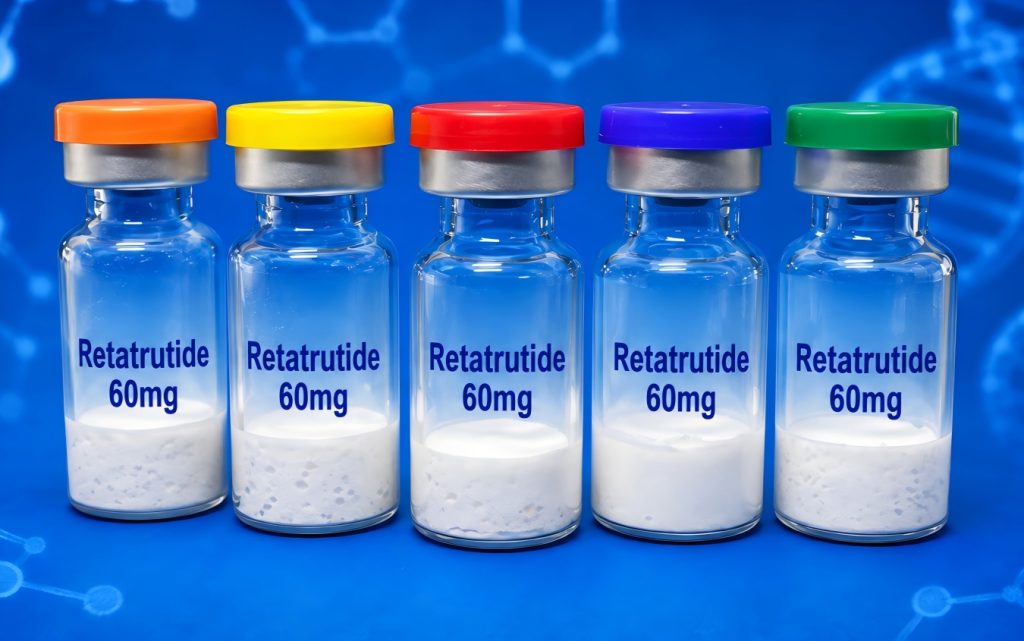
Retatrutide is now one of the most closely watched molecules in metabolic research. Phase 3 headlines are attracting global attention—but clinical trial results answer a very different question from research-material quality.
A Phase 3 result tells researchers what happened with a controlled investigational drug product.
It does not prove that every vial labeled “Retatrutide” contains correctly identified LY3437943.
For B2B laboratories, that distinction matters.
What Is Retatrutide?
Retatrutide (LY3437943, CAS 2381089-83-2) is an investigational peptide designed to activate three receptor systems:
- GIP receptor;
- GLP-1 receptor;
- glucagon receptor.
This has made terms such as Retatrutide peptide, Retatrutide triple agonist, LY3437943, GIP/GLP-1/glucagon agonist and Retatrutide research peptide increasingly important in metabolic research.
Phase 3 Data Does Not Validate a Research Vial
Retatrutide has now generated major Phase 3 research headlines through the TRIUMPH clinical program.
But professional buyers should separate two questions:
Clinical question: What did a controlled Lilly investigational product do in a clinical trial?
Procurement question: Does the research material being supplied actually match the expected Retatrutide specification?
Those are not interchangeable.
A vial carrying the Retatrutide name still requires appropriate identity and quality documentation.
Why “99%+ HPLC” Is Only Part of the Answer
A high Retatrutide HPLC purity value can provide useful information about chromatographic purity.
It does not independently answer:
- Is the principal compound really LY3437943?
- What exact chemical or salt form is present?
- Does the measured molecular mass match the expected material?
- What peptide-related impurities are present?
- Is the result specific to the supplied batch?
This is why professional Retatrutide sourcing should consider identity and purity separately.

What Do Retatrutide Reviews Say?
Online experiences are highly mixed.
Positive discussions frequently mention perceived:
- appetite reduction;
- lower food-related thoughts;
- smaller portions;
- body-weight changes.
Negative discussions include:
- nausea;
- vomiting;
- gastrointestinal discomfort;
- fatigue;
- very low appetite;
- sleep-related complaints;
- general weakness.
These reports are anecdotal.
Product identity, purity, source, concurrent substances and individual health conditions are rarely controlled.
Online reviews cannot establish the quality, safety or efficacy of a research-grade Retatrutide batch.
What Should B2B Buyers Verify?
1. Confirm Molecular Identity
Documentation should clearly identify the expected Retatrutide / LY3437943 material.
2. Review HPLC Purity
HPLC is useful for evaluating chromatographic purity and related impurities.
But:
purity does not automatically prove identity.
3. Review MS or LC-MS Identity Data
Where appropriate, mass spectrometry or LC-MS can provide additional evidence that the supplied material corresponds to the expected molecular species.
4. Confirm the Exact Chemical Form
Retatrutide records may refer to different chemical or salt-related representations.
Professional buyers should verify the actual form supplied against the batch-specific COA rather than relying only on a generic database entry.
5. Request Batch-Specific Documentation
Depending on the research application, buyers may consider reviewing:
- Certificate of Analysis;
- HPLC chromatogram;
- MS / LC-MS identity data;
- exact chemical or salt form;
- peptide-related impurity information;
- batch/lot number;
- SDS;
- storage specification;
- lot traceability.

Retatrutide Research Peptide from Sunone
Sunone (Hong Kong) Biopharmaceutical International Technology Co., Limited supplies Retatrutide for qualified laboratory research and biotechnology manufacturing applications.
Current product information includes:
Product: Retatrutide
Development Name: LY3437943 / LY-3437943
CAS: 2381089-83-2
Molecular Formula: C221H342N46O68
Molecular Weight: 4731 g/mol
Grade: Research Grade
Purity: ≥99.6% by HPLC
Form: Lyophilized Powder
Storage: 2–8°C
Documentation: COA, SDS and Specification Sheet available
Availability: Made to order / B2B quotation
Multiple vial specifications are available for qualified business projects.
Looking for a Retatrutide supplier with batch-specific analytical documentation?
View Sunone Retatrutide Specifications:
Send Sunone your required quantity, specification, packaging format and analytical-documentation requirements for a current B2B quotation.
FAQ
What is LY3437943?
LY3437943 is the development designation for Retatrutide, an investigational GIP, GLP-1 and glucagon receptor agonist.
Is Retatrutide FDA approved?
As of September 2026, Retatrutide remains investigational and has not been approved for public use.
Does Phase 3 success prove that research-market Retatrutide is authentic?
No. Clinical-trial results apply to the investigational material used in the controlled trial. Separately sourced research material requires its own identity and quality verification.
Does 99%+ HPLC prove Retatrutide identity?
Not by itself. HPLC purity and molecular identity are different analytical questions.
What should B2B buyers request from a Retatrutide supplier?
Professional buyers may consider requesting a batch-specific COA, HPLC data, MS/LC-MS identity information, exact chemical-form specification, SDS and lot traceability.
This content is provided for scientific and educational purposes only. SUNONE research peptide is for qualified labrtorynt, diagnois, druc tor mmatct or veteimant, use.research only, Not for human consumption, clinical treame. Purchasers are responsible for complying with applicable laws and regulations in their jurisdiction.
Leave a Reply