

KLOW peptide blends are increasingly visible in research-product searches.
But one important detail is often overlooked:
KLOWGLOW Plus is not one peptide molecule.
It is a multi-component research formulation combining GHK-Cu, BPC-157, TB-500 and KPV.
That distinction changes how laboratories should interpret molecular identity, purity, analytical testing and published research.
What Is KLOWGLOW Plus?
KLOWGLOW Plus is a four-component lyophilized research blend containing:
GHK-Cu — a copper-binding tripeptide complex.
BPC-157 — a synthetic 15-amino-acid peptide.
TB-500 — commonly identified as the acetylated Thymosin Beta-4 17–23 fragment, Ac-LKKTETQ.
KPV — the tripeptide Lys-Pro-Val.
Because these are four separate chemical entities, KLOWGLOW Plus does not have one meaningful molecular formula, molecular weight or CAS number for the complete formulation.
Each component retains its own molecular identity.

KLOW vs GLOW: What Is the Difference?
“KLOW” and “GLOW” are market formulation names rather than names of individual chemical substances.
The terminology can also vary among suppliers.
KLOW commonly refers to a blend containing:
GHK-Cu + BPC-157 + TB-500 + KPV.
Related GLOW formulations commonly contain GHK-Cu, BPC-157 and TB-500 without KPV.
For laboratories, however, the acronym itself should never replace the actual component specification.
Why Component Ratio Matters
A label stating “80 mg KLOW” tells researchers the total mass of a formulation.
It does not, by itself, tell them how much of each component is present.
That creates an important procurement distinction:
total blend mass is not the same as individual component quantity.
Different suppliers may use different formulation ratios.
For reproducible research, laboratories should therefore verify the amount of GHK-Cu, BPC-157, TB-500 and KPV against the applicable batch specification or Certificate of Analysis.
What Does the Research Actually Support?
Each component has its own research literature.
GHK-Cu has been investigated in extracellular-matrix, copper-peptide and skin-related biology.
BPC-157 has a substantial preclinical literature involving tissue-related pathways, although human evidence remains limited.
TB-500 is associated with a short region derived from Thymosin Beta-4 and is researched in relation to actin-associated and cellular-migration pathways.
KPV has been studied in epithelial and inflammatory-signaling models, including research involving PepT1, NF-κB and MAPK pathways.
But there is an important evidence boundary:
research on four individual components does not automatically demonstrate synergy or efficacy of the four-component KLOWGLOW formulation.
The blend itself requires its own experimental validation.

Why Online KLOW Reviews Are Difficult to Interpret
Public KLOW reviews are mixed.
Some users report perceived changes in skin appearance, hair, nails or recovery.
Others report no noticeable result or unwanted experiences such as fatigue, nausea, anxiety, sleep disruption or palpitations.
These experiences cannot establish the performance of a research blend.
They also create a fundamental attribution problem:
when four components are used simultaneously, an observed result cannot automatically be assigned to one specific peptide.
Source quality, formulation ratio, analytical identity and other variables may also differ among products discussed online.
Consumer testimonials therefore cannot replace controlled research.
Does a Peptide Blend Have One CAS Number?
No single CAS number should be assumed for a multi-component formulation such as KLOWGLOW Plus.
GHK-Cu, BPC-157, TB-500 and KPV are separate chemical entities.
The complete mixture should therefore be described through its component composition rather than inventing a molecular formula, molecular weight or CAS number for the blend.
This is particularly important for technical documentation and B2B procurement.
Why HPLC Purity Needs Context
HPLC is valuable for peptide quality analysis.
For a four-component blend, however, the phrase “HPLC purity” requires more context than it does for a single peptide.
Researchers should ask:
Does the analytical method resolve the individual components?
Are component identities independently supported?
Does the reported result refer to individual raw materials or the final formulation?
Are identity data such as mass-spectrometry results available where applicable?
A single purity percentage should not replace component-level analytical understanding.
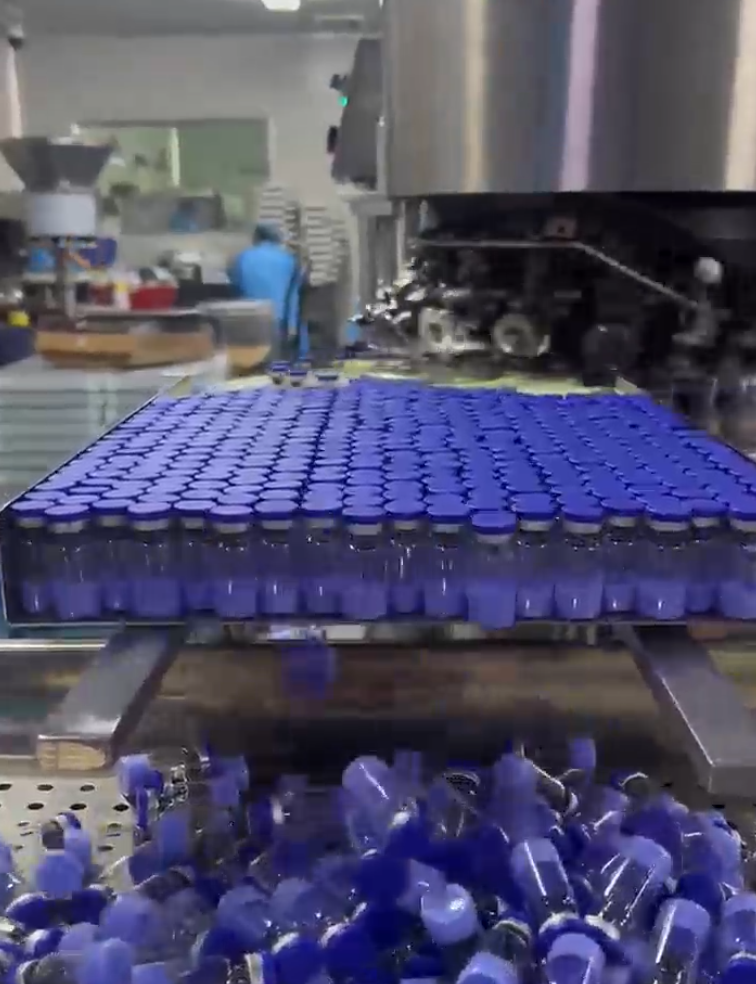
Why the Batch COA Is Especially Important
For KLOWGLOW Plus, the Certificate of Analysis is more than a generic quality document.
It helps connect the supplied vial to a defined formulation.
Laboratories should verify the applicable:
component list, component amounts or ratio, lot number, analytical methods, purity specifications, identity information and storage requirements.
This becomes especially important when market definitions of “KLOW” or “GLOW” differ between suppliers.
Sunone KLOWGLOW Plus Research Blend
Sunone (Hong Kong) Biopharmaceutical International Technology Co., Limited supplies KLOWGLOW Plus for qualified laboratory, analytical and biopharmaceutical research and manufacturing applications.
Current Sunone product information identifies the formulation as:
GHK-Cu + BPC-157 + TB-500 + KPV
with an 80 mg research-blend configuration.
The material is supplied in lyophilized form with batch documentation including Certificate of Analysis, Safety Data Sheet and Specification Sheet.
Because KLOWGLOW Plus is a multi-component formulation, the exact component identity, amount, ratio and applicable analytical specifications should always be verified against the batch-specific documentation.
View the Sunone KLOWGLOW Plus GHK-Cu BPC-157 TB-500 KPV research blend product page for current specifications, batch documentation and B2B sourcing information.
For biotechnology companies comparing a KLOW peptide supplier, KLOWGLOW manufacturer or multi-component research peptide blend supplier, component identity and formulation traceability provide a stronger procurement framework than marketing claims.
Final Perspective
KLOWGLOW Plus demonstrates an important principle in peptide research:
a blend is not a new single molecule.
GHK-Cu, BPC-157, TB-500 and KPV remain four different research components with different structures and separate bodies of evidence.
Before purchasing or designing experiments around a KLOW research blend, laboratories should ask:
What exactly is in the formulation?
What is the amount of each component?
Does the COA match the supplied batch?
How was each component identified?
And does the published evidence concern the individual peptide or the complete blend?
Those questions provide a stronger scientific basis for KLOWGLOW research than the product name alone.
This content is provided for scientific and educational purposes only. SUNONE research peptide is for qualified labrtorynt, diagnois, druc tor mmatct or veteimant, use.research only, Not for human consumption, clinical treame. Purchasers are responsible for complying with applicable laws and regulations in their jurisdiction.
Leave a Reply