
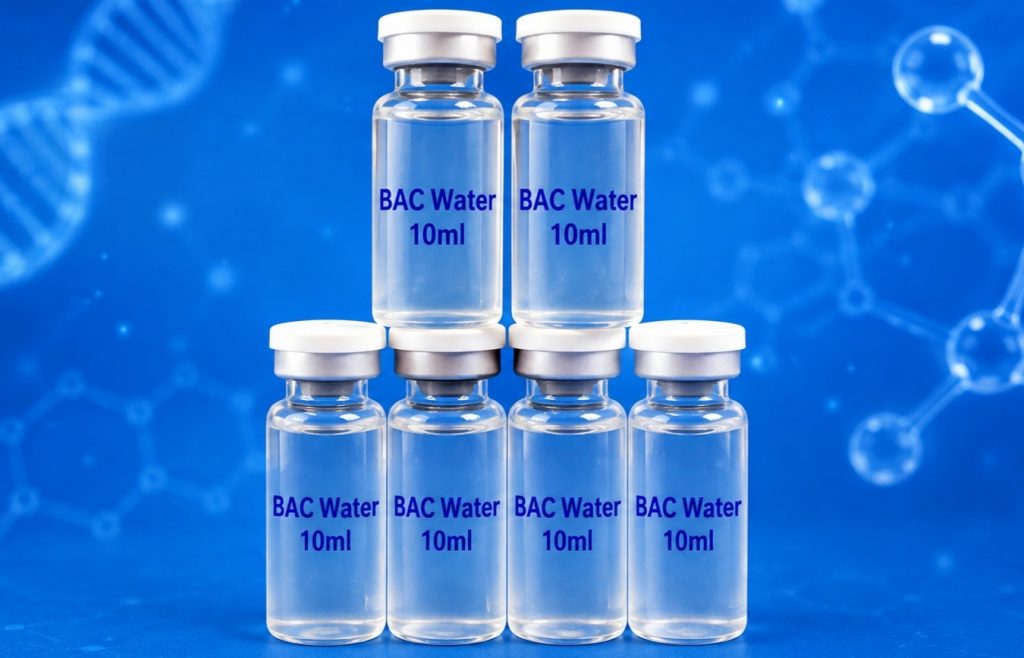
BAC Water is often described simply as “water with benzyl alcohol.”
For laboratory procurement, that description is incomplete.
Bacteriostatic Water is a formulated aqueous solution, not a single chemical compound, and its quality depends on more than the presence of water alone.
Preservative concentration, compatibility, sterility-related specifications, storage conditions and batch documentation can all matter.
What Is BAC Water?
BAC Water, also known as Bacteriostatic Water, is an aqueous formulation containing a bacteriostatic preservative such as benzyl alcohol.
In research environments, it may be used as a supporting laboratory solution in controlled preparation, formulation-development and compatible reconstitution workflows.
Because BAC Water is a mixture, the complete formulation does not have one meaningful molecular formula or molecular weight.
Chemical identifiers such as CAS 100-51-6 refer specifically to the benzyl alcohol component, not to the complete BAC Water formulation.
BAC Water vs Sterile Water: What Is the Difference?
“Sterile” and “bacteriostatic” describe different properties.
Sterile water is intended to be free from viable microorganisms when manufactured and packaged according to the applicable specification.
Bacteriostatic water includes an antimicrobial preservative designed to inhibit bacterial proliferation under the conditions defined for that formulation.
This does not mean BAC Water can compensate for poor laboratory handling.
Bacteriostatic does not mean self-sterilizing.
A contaminated vial should not be assumed safe simply because it contains benzyl alcohol.

Why Benzyl Alcohol Concentration Matters
Benzyl alcohol is the defining preservative associated with conventional bacteriostatic-water formulations.
However, the exact concentration should not be assumed from the product name alone.
Different specifications may use different preservative concentrations.
For B2B and laboratory procurement, buyers should therefore confirm:
- preservative identity;
- preservative concentration;
- applicable pH specification;
- storage conditions;
- sterility-related specification where applicable;
- and batch-specific documentation.
A label stating only “BAC Water” provides less analytical information than a defined product specification.
BAC Water Is Not One Chemical Substance
Water and benzyl alcohol are separate molecules.
The formulation should therefore not be assigned an artificial single CAS number, molecular formula or molecular weight.
For technical documentation, a better approach is to describe the material as a formulated aqueous mixture and separately identify relevant components.
This distinction is especially useful for SDS preparation, customs documentation, laboratory purchasing and quality-control records.
Why Compatibility Matters in Research
A laboratory diluent should not be selected only because it is commonly used with other materials.
Compatibility depends on the research compound and the experimental protocol.
Relevant variables may include:
pH, preservative concentration, peptide or protein stability, ionic environment, storage time and analytical method.
For this reason, researchers should verify that BAC Water is compatible with the particular research material and workflow being studied.
A diluent that is appropriate for one formulation is not automatically appropriate for every peptide, protein or analytical application.
What Do Online BAC Water Reviews Actually Tell Us?
Public discussions about bacteriostatic water are mixed.
Positive comments often focus on convenience in multi-use laboratory or reconstitution workflows.
Negative comments frequently concern inconsistent product quality, uncertain benzyl alcohol concentration, stinging or burning sensations, questionable online suppliers and confusion between true bacteriostatic water and generic “reconstitution solutions.”
These anecdotes do not verify the quality of a specific research batch.
They do, however, highlight an important procurement principle:
formulation identity and batch documentation matter more than the words printed on the front label.
Why Sterility and Endotoxin Are Different Questions
Laboratory buyers should also distinguish between chemical purity, sterility and endotoxin control.
These are separate quality attributes.
A clear solution can still fail microbiological or endotoxin requirements.
Likewise, a high-quality benzyl alcohol raw material does not automatically establish the microbial quality of a finished aqueous formulation.
Where those specifications are relevant to the intended research application, they should be verified using appropriate batch documentation and validated testing.
Why a Batch-Specific COA Matters
A Certificate of Analysis should correspond to the actual manufacturing lot being supplied.
Depending on the product specification, relevant documentation may include:
composition, preservative concentration, appearance, pH, analytical results, lot number, storage conditions and applicable microbiological specifications.
The COA should be reviewed together with the product specification and SDS.
A generic certificate from another lot does not provide the same level of traceability.
Sunone BAC Water Research Solution
Sunone (Hong Kong) Biopharmaceutical International Technology Co., Limited supplies BAC Water for qualified laboratory research, analytical, formulation-development and manufacturing applications.
Current Sunone product information includes:
BAC Water / Bacteriostatic Water
Formulated aqueous solution
Benzyl alcohol as the relevant preservative component
3 mL and 10 mL laboratory formats
Research Grade
Certificate of Analysis
Safety Data Sheet
Specification Sheet
Batch-specific documentation where applicable
Final composition, preservative concentration, sterility specification, storage conditions and analytical information should always be verified against the applicable batch documents.
View the Sunone BAC Water / Bacteriostatic Water research solution product page for current specifications, documentation and B2B sourcing information.
For biotechnology companies comparing a BAC Water supplier, Bacteriostatic Water manufacturer, OEM laboratory solution supplier or private-label BAC Water supplier, formulation transparency and batch traceability provide stronger procurement criteria than price or product naming alone.
Final Perspective
BAC Water appears simple because most of the formulation is water.
Analytically, however, “simple” does not mean “undefined.”
For research procurement, the useful questions are:
What preservative is present?
At what concentration?
What is the applicable pH range?
Is the formulation compatible with the intended research material?
Which microbiological specifications apply?
And does the COA correspond to the supplied batch?
Those questions provide a stronger foundation for laboratory BAC Water procurement than relying on the name “bacteriostatic water” alone.
This content is provided for scientific and educational purposes only. SUNONE research peptide is for qualified labrtorynt, diagnois, druc tor mmatct or veteimant, use.research only, Not for human consumption, clinical treame. Purchasers are responsible for complying with applicable laws and regulations in their jurisdiction.
Leave a Reply