
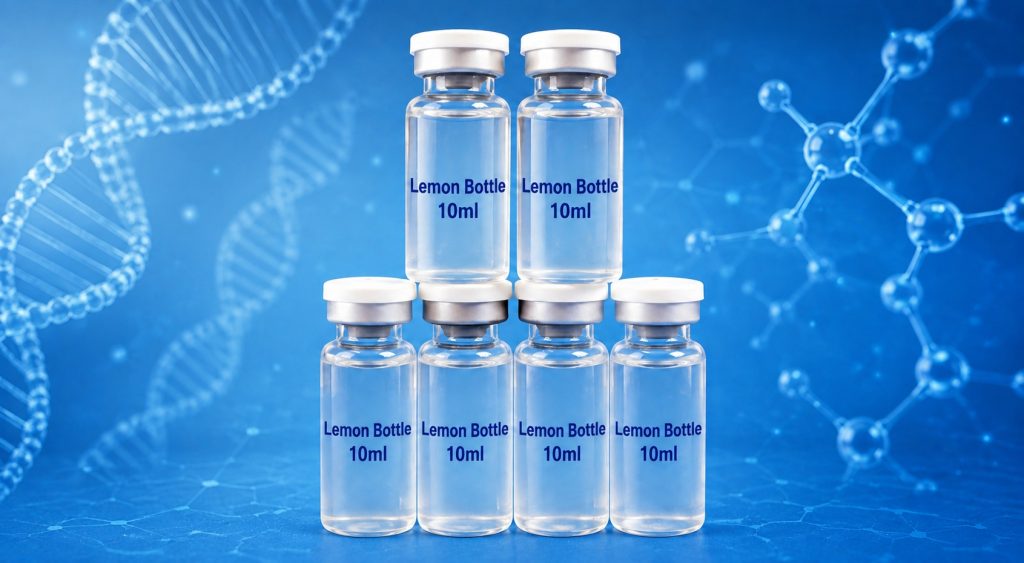
Search for Lemon Bottle and most pages focus on aesthetic marketing.
For biotechnology laboratories and professional B2B buyers, however, a more fundamental question comes first:
What is actually in the formulation?
Lemon Bottle is not one chemical molecule. It is a multi-component solution commonly associated with ingredients including riboflavin, bromelain and lecithin.
That distinction matters for analytical testing, documentation and regulatory classification.
What Is Lemon Bottle?
Lemon Bottle Ampoule Solution is a liquid multi-ingredient formulation.
The principal declared ingredients commonly associated with the formulation include:
Riboflavin (Vitamin B2)
Bromelain
Lecithin
Sunone supplies Lemon Bottle Ampoule Solution for qualified B2B research and manufacturing procurement.
Because it contains multiple ingredients, the complete formulation should not be assigned one artificial molecular formula, molecular weight or CAS number.
Each component has its own chemical identity.
Why Lemon Bottle Does Not Have One CAS Number
CAS numbers normally identify defined chemical substances.
A formulation containing several chemically different components is a mixture.
Therefore, statements such as “Lemon Bottle CAS number” can be misleading unless they refer to a specific ingredient.
For technical documentation, the correct approach is to identify:
- the complete component specification;
- the identity of relevant ingredients;
- the concentration or amount of each specified component;
- and the applicable batch documentation.

Riboflavin, Bromelain and Lecithin Are Not the Same Type of Material
The three commonly declared components have very different chemical characteristics.
Riboflavin is Vitamin B2 and serves as a precursor for flavin coenzymes such as FAD and FMN.
Bromelain is not a single small molecule. It describes a mixture of proteolytic enzymes derived from pineapple tissue.
Lecithin is also not one defined molecule. It refers to a phospholipid-rich material whose composition can vary depending on source and processing.
That creates a more complicated analytical problem than testing one purified peptide.
Why Ingredient Identity Matters
A commercial product name does not establish chemical identity.
This is particularly important in markets where products carrying similar packaging or branding may come from different sources.
For professional procurement, the relevant questions are:
Does the supplied batch match the declared formulation?
Can important components be analytically identified?
Does the Certificate of Analysis correspond to the actual batch?
Are the specification and regulatory documents consistent with the destination market?
These questions provide more useful information than marketing terminology alone.
What Does the Scientific Literature Actually Support?
Research literature exists for individual materials such as riboflavin, bromelain and phospholipid compounds.
However, evidence concerning individual ingredients should not automatically be presented as evidence for the complete Lemon Bottle formulation.
This distinction is essential.
Component-level evidence is not the same as formulation-level evidence.
A multi-ingredient product requires its own characterization before conclusions can be drawn about the combined formulation.
Why Online Reviews Need Caution
Public Lemon Bottle reviews are mixed.
Some consumers report satisfaction with aesthetic services marketed under the Lemon Bottle name.
Others report little or no visible result.
These experiences have several limitations.
They may involve different providers, different product sources and potentially different formulations.
A consumer review also cannot verify ingredient identity, concentration, purity or batch consistency.
For B2B procurement, testimonials should therefore never replace analytical documentation.
Why Regulatory Classification Matters
Regulatory treatment of Lemon Bottle can vary between jurisdictions and can also depend on how a product is presented and intended to be used.
A formulation promoted as a cosmetic, laboratory material or medicinal product may be subject to very different regulatory requirements.
This makes destination-country compliance particularly important for importers and distributors.
Professional buyers should confirm applicable rules before purchasing, importing, distributing or marketing any multi-component formulation.

What Should a B2B Buyer Check?
For a Lemon Bottle research solution, professional buyers should consider more than the product name.
Useful documentation may include:
Certificate of Analysis (COA) — batch-specific analytical information.
Safety Data Sheet (SDS) — handling and hazard information.
Specification Sheet — defined formulation and product requirements.
Lot Identification — linkage between documentation and supplied units.
Component Information — identification of principal formulation ingredients.
These documents create traceability between the declared formulation and the material actually supplied.
Sunone Lemon Bottle Ampoule Solution
Sunone (Hong Kong) Biopharmaceutical International Technology Co., Limited supplies Lemon Bottle Ampoule Solution for qualified B2B research and manufacturing procurement.
Current Sunone product information identifies:
Lemon Bottle Ampoule Solution
10 mL liquid format
Multi-component formulation
Riboflavin as a declared principal ingredient
Bromelain as a declared principal ingredient
Lecithin as a declared principal ingredient
Certificate of Analysis
Safety Data Sheet
Specification Sheet
Batch documentation where applicable
View the Sunone Lemon Bottle Ampoule Solution product page for current specifications, documentation, MOQ and B2B quotation information.
For professional buyers comparing a Lemon Bottle supplier, Lemon Bottle manufacturer, Lemon Bottle OEM supplier or multi-ingredient research solution supplier, formulation identity and batch traceability are more useful procurement criteria than consumer marketing claims.
Final Perspective
Lemon Bottle illustrates an important quality-control principle:
a brand or formulation name is not an analytical identity.
For a multi-component product, professional evaluation should focus on:
What ingredients are declared?
What does the batch specification require?
How are relevant components verified?
Does the COA belong to the supplied lot?
And is the product classification appropriate for the destination market?
For B2B research procurement, those questions provide a stronger foundation than relying on aesthetic claims or online testimonials.
This content is provided for scientific and educational purposes only. SUNONE research peptide is for qualified labrtorynt, diagnois, druc tor mmatct or veteimant, use.research only, Not for human consumption, clinical treame. Purchasers are responsible for complying with applicable laws and regulations in their jurisdiction.
Leave a Reply