
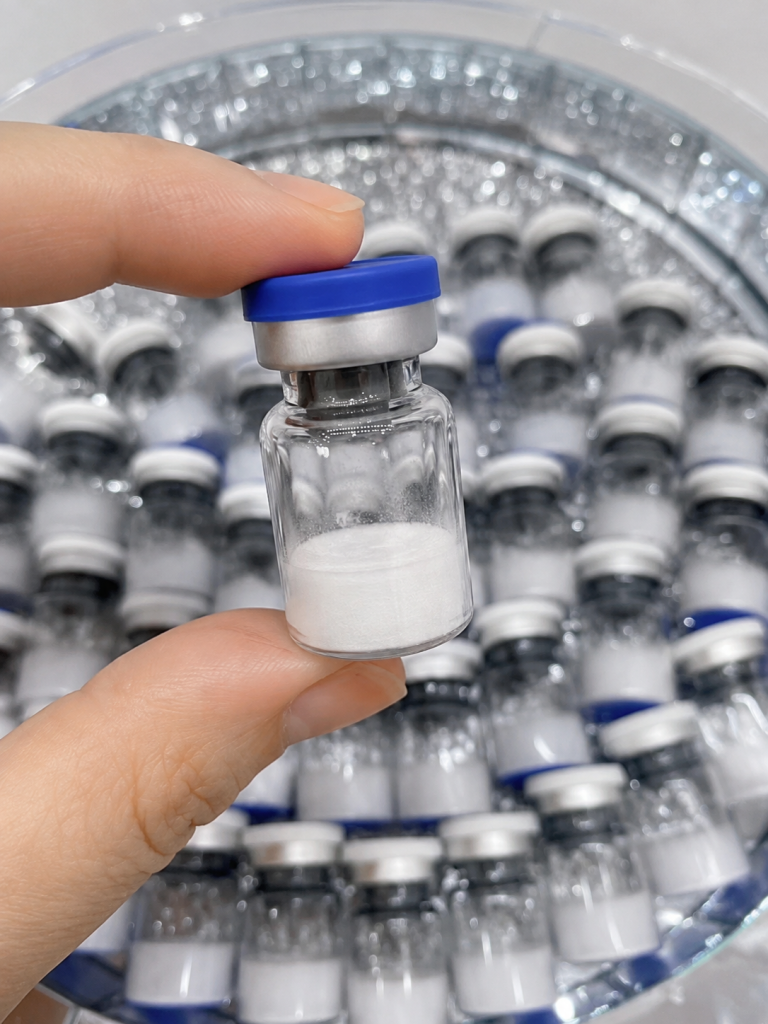
BPC-157 + TB-500 is frequently described online as a “Wolverine” peptide blend.
For laboratory researchers and biotechnology buyers, however, the nickname provides very little analytical information.
The more important point is:
BPC-157 + TB-500 is a two-component formulation—not one new peptide molecule.
That distinction matters when evaluating identity, purity, component quantity, research evidence and batch documentation.
What Is a BPC-157 + TB-500 Research Blend?
A BPC-157 + TB-500 blend combines two chemically different research peptides in one lyophilized formulation.
Sunone currently supplies two 1:1 configurations:
10 mg total: BPC-157 5 mg + TB-500 5 mg
20 mg total: BPC-157 10 mg + TB-500 10 mg
The 1:1 ratio describes the intended component quantities.
It does not mean that BPC-157 and TB-500 become one new chemical entity.
Why the Blend Does Not Have One CAS Number
BPC-157 and TB-500 have different molecular identities.
BPC-157 is a synthetic 15-amino-acid peptide commonly identified by CAS 137525-51-0.
TB-500 is commonly identified as the N-terminally acetylated 17–23 fragment of Thymosin Beta-4, with the sequence Ac-LKKTETQ.
Mixing the two does not create a single molecule with a new molecular formula or molecular weight.
For technical documentation, the blend should therefore be described through its individual components and formulation ratio.
TB-500 Is Also Not Full-Length Thymosin Beta-4
Another important distinction concerns the identity of TB-500.
Analytical research has identified TB-500 as the acetylated seven-residue sequence:
Ac-LKKTETQ
This corresponds to residues 17–23 of human Thymosin Beta-4.
It should not automatically be treated as equivalent to the complete 43-amino-acid Thymosin Beta-4 molecule.
This distinction matters when researchers interpret published literature.
Does Combining BPC-157 and TB-500 Prove Synergy?
No.
BPC-157 has been investigated primarily in preclinical models involving tissue remodeling, cellular migration, inflammatory signaling and related biological pathways.
TB-500 and Thymosin-Beta-related sequences have separate research histories.
But evidence involving each component individually does not automatically demonstrate that a 1:1 BPC-157 + TB-500 blend has synergistic biological activity.
Individual evidence is not combination evidence.
The complete formulation requires appropriate experimental validation.
What Do Online BPC-157 + TB-500 Reviews Tell Us?
Public experiences are mixed.
Some users report perceived improvements in discomfort or recovery.
Others report little or no noticeable change.
Negative anecdotes include fatigue, nausea, gastrointestinal symptoms, anxiety, sleep disturbance and other unwanted experiences.
These reports have major limitations.
Product identity is often unknown, suppliers differ, other interventions may be used simultaneously, and natural recovery can influence the result.
They are also not reviews of Sunone BPC-157 + TB-500 research material.
Consumer testimonials should therefore not replace controlled research or analytical documentation.
Why “99% Purity” Does Not Describe the Whole Blend
Purity is only one analytical attribute.
For a two-component formulation, laboratories should distinguish four different questions:
Identity — are BPC-157 and TB-500 the expected molecular components?
Purity — what does the chromatographic analysis show about each relevant material?
Net content — how much peptide material is actually present?
Ratio — do the measured component quantities support the intended 1:1 formulation?
A single HPLC purity percentage cannot answer all four questions.
Why HPLC and Mass Spectrometry Can Be Complementary
HPLC can provide useful information about chromatographic purity.
Mass spectrometry can provide complementary evidence supporting molecular identity.
For a multi-component research blend, analytical methods should ideally be capable of distinguishing the expected components rather than treating the vial as though it contained one peptide.
This is particularly important when BPC-157 and TB-500 are supplied at defined component quantities.
Why Batch-Specific COA Documentation Matters
A generic product specification is useful for defining the target formulation.
A batch-specific Certificate of Analysis answers a different question:
what was measured for the actual production lot?
Depending on the analytical programme, useful documentation may include:
product identity, component quantities, lot number, HPLC results, identity testing, net peptide content, storage specifications and release information.
Researchers should therefore match the COA to the batch being supplied.
Sunone BPC-157 + TB-500 Research Blend
Sunone (Hong Kong) Biopharmaceutical International Technology Co., Limited supplies BPC-157 + TB-500 for qualified laboratory, analytical and biopharmaceutical research and manufacturing applications.
Current Sunone configurations include:
10 mg total — BPC-157 5 mg + TB-500 5 mg
20 mg total — BPC-157 10 mg + TB-500 10 mg
The product is supplied as a lyophilized Research Grade formulation with applicable Certificate of Analysis, Safety Data Sheet and Specification Sheet documentation.
Because it is a multi-component formulation, exact component identity, quantity, ratio, purity and chemical form should always be verified against the applicable batch documentation.
View the Sunone BPC-157 + TB-500 Research Blend product page for current specifications, analytical documentation and B2B sourcing information.
For biotechnology companies comparing a BPC-157 TB-500 supplier, Wolverine research blend manufacturer or multi-component peptide manufacturer, component identity, ratio verification and batch traceability provide stronger procurement criteria than marketing claims.
Final Perspective
A BPC-157 + TB-500 blend may have a simple 1:1 ratio, but its analytical interpretation is not simply “one peptide.”
For reproducible research, laboratories should ask:
Are both molecular components correctly identified?
Does the measured content support the intended ratio?
How was purity determined?
Does identity testing support each component?
Does the scientific evidence concern the individual peptides or the combination?
And does the COA correspond to the supplied batch?
Those questions provide a stronger foundation for BPC-157 + TB-500 research than the term “Wolverine blend” alone.
This content is provided for scientific and educational purposes only. SUNONE research peptide is for qualified labrtorynt, diagnois, druc tor mmatct or veteimant, use.research only, Not for human consumption, clinical treame. Purchasers are responsible for complying with applicable laws and regulations in their jurisdiction.
Leave a Reply