
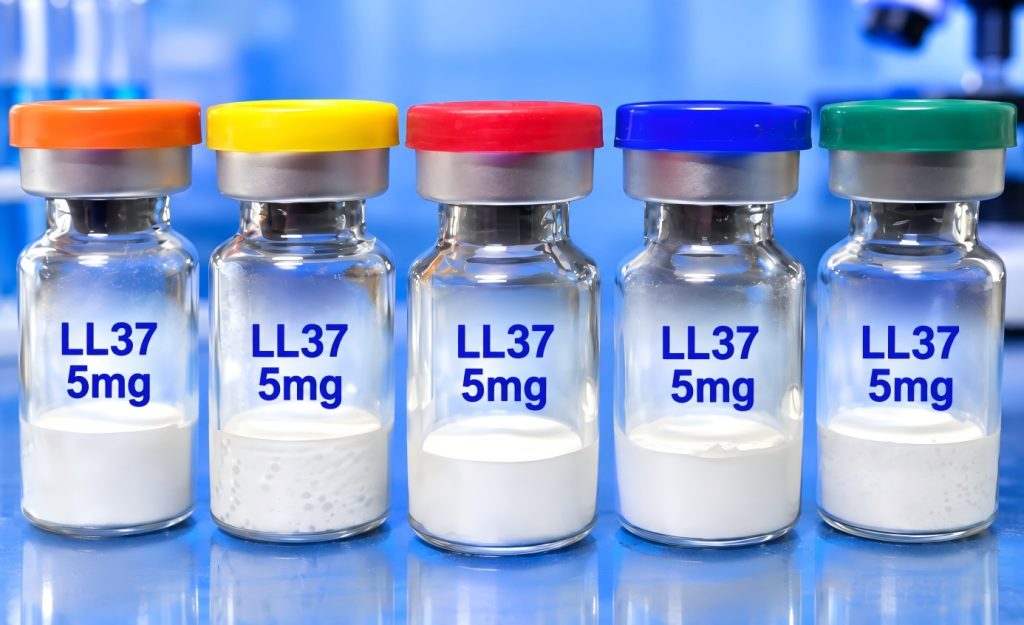
LL-37 is often described online simply as an “antimicrobial peptide.” That description is technically incomplete.
For professional laboratories and B2B buyers, LL-37 is better understood as a multifunctional human cathelicidin peptide involved in host-defense, inflammatory and cellular-signaling research.
That complexity makes one thing especially important:
Verify the material — not just the label.
What Is LL-37?
LL-37, also known as Cathelicidin LL-37, LL37, CAP-18 and Ropocamptide, is a 37-amino-acid peptide derived from the human cathelicidin precursor hCAP-18.
Its sequence is:
LLGDFFRKSKEKIGKEFKRIVQRIKDFLRNLVPRTES
LL-37 is widely studied in laboratory research involving:
- innate host-defense mechanisms;
- antimicrobial peptide biology;
- membrane interactions;
- inflammatory signaling;
- immune-cell recruitment;
- epithelial biology;
- peptide characterization.

LL-37 Is More Than an Antimicrobial Peptide
One reason LL-37 attracts research interest is that its biological activity is not limited to direct interaction with microorganisms.
Scientific literature also describes roles involving:
- chemotaxis;
- cytokine and chemokine signaling;
- epithelial-cell activation;
- inflammatory regulation;
- angiogenesis;
- tissue-repair-related pathways.
That multifunctionality is scientifically interesting — but it also means that simplistic claims such as “LL-37 kills pathogens” leave out much of the biology.
For researchers, context matters.
What Do LL-37 Reviews Say?
Online discussions about LL-37 are highly mixed.
Some users claim perceived improvements involving infection-related or gastrointestinal symptoms.
Others describe negative experiences such as:
- fatigue;
- brain fog;
- body aches;
- flu-like or inflammatory sensations;
- worsening of pre-existing symptoms.
These reports are anecdotal.
The identity and purity of the material, other compounds being used, health status and experimental conditions are usually unknown.
Online reviews therefore cannot establish LL-37 safety, efficacy or product quality.
For professional research procurement, analytical documentation is far more useful.
Choosing an LL-37 Supplier: What Should B2B Buyers Verify?
1. Confirm the 37-Amino-Acid Sequence
Documentation should identify the expected LL-37 sequence:
LLGDFFRKSKEKIGKEFKRIVQRIKDFLRNLVPRTES
For a peptide supplier, sequence identity is more meaningful than relying on a product name alone.
2. Review HPLC Purity
LL-37 HPLC analysis can provide information about chromatographic purity and peptide-related impurities.
However:
A high HPLC percentage does not independently prove molecular identity.
3. Review MS or LC-MS Identity Data
Where available, LL-37 mass spectrometry or LC-MS can provide additional support for the expected molecular identity.
This is especially relevant when evaluating modified, degraded or impurity-containing peptide material.
4. Check the Batch-Specific COA
A professional LL-37 Certificate of Analysis should correspond to the actual production lot.
Depending on project requirements, professional buyers may consider reviewing:
- HPLC purity;
- MS or LC-MS identity;
- amino-acid sequence;
- molecular weight;
- batch/lot number;
- SDS;
- storage conditions;
- applicable impurity information.

LL-37 Research Peptide from Sunone
Sunone (Hong Kong) Biopharmaceutical International Technology Co., Limited supplies LL-37 for qualified laboratory research, analytical development and manufacturing applications.
Current product information includes:
Product: LL-37
Synonyms: Cathelicidin LL-37 / LL37 / CAP-18 / Ropocamptide
Sequence: LLGDFFRKSKEKIGKEFKRIVQRIKDFLRNLVPRTES
Molecular Formula: C205H340N60O53
Molecular Weight: 4493 g/mol
Grade: Research Grade
Purity: ≥99% by HPLC
Form: Lyophilized Powder
Documentation: Batch-specific analytical information, COA, SDS and Specification Sheet available
Looking for an LL-37 research peptide supplier with batch-specific quality documentation?
View LL-37 Specifications:
Send Sunone your required quantity, purity specification, packaging format and analytical-documentation requirements to discuss a B2B quotation.
LL-37 FAQ
What is LL-37?
LL-37 is a 37-amino-acid human cathelicidin-derived peptide widely studied in antimicrobial, innate-immunity and cellular-signaling research.
Is LL-37 also called CAP-18?
LL-37 is derived from the hCAP-18 precursor and may appear in supplier or database searches alongside terms such as CAP-18, Cathelicidin LL-37 and Ropocamptide.
What is the molecular weight of LL-37?
Sunone lists the molecular weight as approximately 4493 g/mol.
Does 99% HPLC prove LL-37 identity?
No. HPLC primarily addresses chromatographic purity. Appropriate identity testing such as MS or LC-MS can provide additional molecular confirmation.
What should buyers request from an LL-37 peptide supplier?
Professional buyers may consider requesting a batch-specific COA, HPLC chromatogram, MS/LC-MS identity data, sequence information, SDS and lot traceability.
This content is provided for scientific and educational purposes only. SUNONE research peptide is for qualified labrtorynt, diagnois, druc tor mmatct or veteimant, use.research only, Not for human consumption, clinical treame. Purchasers are responsible for complying with applicable laws and regulations in their jurisdiction.
Leave a Reply