

KLOW Peptide Research: Can Four Individual Peptide Studies Explain One Blend?
KLOW peptide, also known as a GHK-Cu + BPC-157 + TB-500 + KPV blend, brings four widely discussed…

Selank Peptide Research: Why Do Seven Amino Acids Matter?
Selank peptide is often discussed online in relation to stress, anxiety and cognitive research. But from a peptide-science…
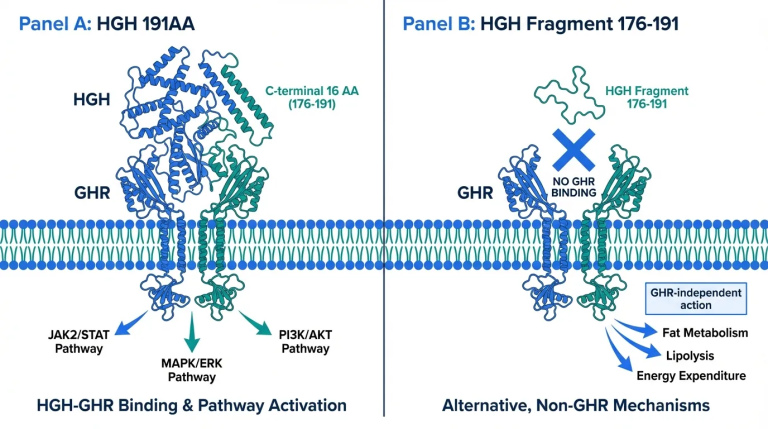
HGH Fragment 176-191 vs HGH: Why the Name Can Be Misleading
Search for HGH Fragment 176-191 and one question quickly appears: Is HGH Fragment 176-191 simply a smaller version…

Retatrutide Research: Why Target Three Metabolic Receptors Instead of One?
Modern peptide research is increasingly moving from single-receptor signaling toward multi-receptor design. Retatrutide (LY3437943) is a particularly interesting…
Selank Peptide Research: Why Were Three Amino Acids Added to Tuftsin?
Selank peptide contains only seven amino acids: Thr-Lys-Pro-Arg-Pro-Gly-Pro (TKPRPGP) But its sequence tells an interesting story. The first…

Retatrutide Research: Why Does One Peptide Target Three Metabolic Receptors?
Retatrutide (LY3437943) stands out from many metabolic research peptides for one structural idea: One molecule is designed to…

HGH 191AA Research: Why Do the 191 Amino Acids Matter?
When researchers see the term HGH 191AA, attention often goes directly to purity. But there is another important…
Liraglutide Research: Why Is This GLP-1 Analog Long-Acting?
Liraglutide is one of the best-known molecules in the GLP-1 research field. But from a peptide-science perspective, one…
PT-141 Research: Why Is Bremelanotide Different From Conventional Sexual-Function Compounds?
When researchers discuss PT-141, also known as Bremelanotide, it is often grouped together with compounds studied in sexual-function…
Ipamorelin Research: What Does “Selective GH Secretagogue” Really Mean?
Ipamorelin is frequently described as a “selective growth hormone secretagogue.” But what does selective actually mean in peptide…